How Safe Is Geothermal Tourism, Really?
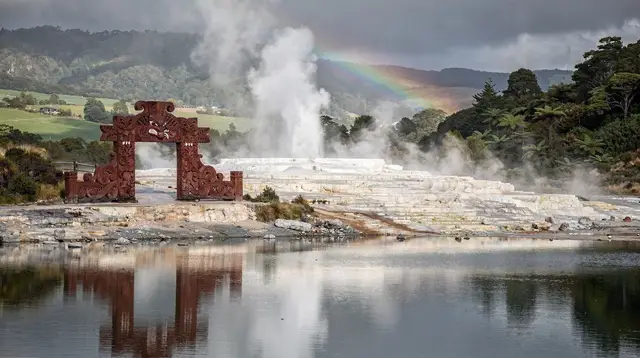
I have stood on a boardwalk at Wai-O-Tapu and felt genuinely uneasy about the ground under my feet, even though I knew, rationally, that thousands of people cross that exact spot every week without incident. That gap between what I knew and what I felt is, I think, the honest starting point for this topic. Rotorua sits inside an active volcanic field. The steam, the mud, the smell are not decoration. They are also, on the whole, extremely well managed — but “well managed” is not the same as “risk-free,” and I’d rather understand where the real edges are than pretend they don’t exist.
What Actually Goes Wrong
Geothermal accidents in this region fall into a small number of repeating categories, and almost none of them happen to people who stayed on the path.
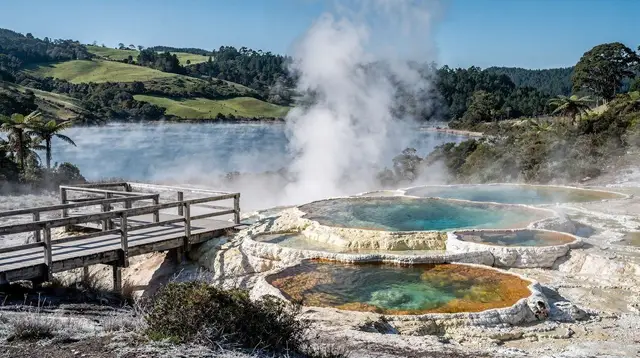
Thin crust and ground collapse. A geothermal field’s surface can look like ordinary dried mud or scrubby ground while sitting over boiling water or mud a short distance below. The crust is not uniform: rain, ground movement, and the geothermal system itself constantly change how thick and how stable it is from one patch to the next. This is why every operating park — Wai-O-Tapu, Hell’s Gate, Waimangu, Te Puia — routes visitors along boardwalks and ropes rather than letting anyone wander. The tested route is the only part of the ground that’s been confirmed safe; a step off it is a step onto ground nobody has checked.
This is also the mechanism behind almost every serious injury reported at geothermal sites over the past two decades: someone left the marked path, often to get a closer photo, and broke through into scalding mud or water.
Gas pooling in low ground. Hydrogen sulfide — the rotten-egg smell that gives Rotorua its reputation — is present across the whole field at background levels that are unpleasant but not dangerous. It becomes a hazard specifically when it collects: in an enclosed hollow, a sheltered dip, or anywhere airflow is blocked, concentrations can build to levels that affect breathing, especially on still, windless days. It’s a heavier-than-air gas, so it settles rather than dispersing on its own. Parks account for this in how trails are laid out, steering routes away from natural traps; the risk for a visitor is mainly in lingering off-trail in a sheltered pocket rather than in simply walking through steam.
Scalding, not just burning. Contact burns from mud pools, hot streams, or splashed water are the most common actual injury at geothermal sites, and they’re rarely dramatic — a hand reaching toward a pool for a photo, a foot stepping into water that looks cooler than it is. Some features sit well above boiling point. At Hell’s Gate / Tikitere, the one site where visitors deliberately enter a mud bath, that’s done in a specifically prepared, temperature-controlled pool, not in the wild features around it — a distinction worth keeping in mind everywhere else.
The Case That Changed Everything
The event that reset how geothermal tourism is regulated across this whole volcanic zone happened offshore, not in Rotorua itself. On 9 December 2019, Whakaari / White Island erupted while a tour group stood on the crater floor, killing 22 people. It remains the clearest illustration of the difference between a managed geothermal park and an active, unpredictable volcanic vent: the parks around Rotorua sit on a stable geothermal field with monitored, repeating features, while Whakaari is a live andesite volcano that can erupt with little warning. Ground landings on the island have not resumed, and I would treat any operator claiming otherwise as a red flag rather than a bargain. What’s offered now, and what I’d stick to, is a boat approach or a scenic flight over the crater — close enough to understand the scale of it, without anyone standing inside it.
It’s worth reading what changed after 2019 before booking any volcano-adjacent activity in this region, and understanding why the Taupō volcanic zone behaves this way at all.
It’s also worth remembering that this landscape has done this before. The 1886 Tarawera eruption killed more than a hundred people and destroyed the Pink and White Terraces in a single night, and Waimangu — the valley you can walk through today — is literally the crater field that eruption created. None of this is presented to unsettle visitors; it’s presented because the guides at these sites take it seriously, and I think visitors should too.
What Actually Keeps It Safe
None of this reads as an argument against visiting — it’s an argument for visiting on the terms the parks set. In practice, that means a short list of habits rather than anxiety: stay on boardwalks and ropes without exception, don’t reach toward pools or vents for a photo, keep children and pets within arm’s reach in geothermal areas, don’t linger in sheltered hollows, and treat sudden changes in smell or steam as something to mention to staff rather than to investigate.
If I’m honest, the visits where I felt most relaxed were the guided ones, simply because someone else was doing the constant, correct judgment calls about which ground to trust. A Wai-O-Tapu entry with a good sense of the schedule is one way to see the highlights independently; for a more personal, slower read on the landscape, an off the beaten track geothermal walk with a local guide puts someone who reads this ground daily between you and the parts of it that aren’t obvious from a map. An eco thermal afternoon tour covers several features in a single guided outing, which also means fewer solo decisions about where exactly to stand.
And a straightforward entry ticket to Wai-O-Tapu is enough on its own if you’re comfortable following the park’s own signage and timing.
None of this compares to Yellowstone in scale, and it doesn’t need to — Rotorua’s parks are smaller, more contained, and more tightly managed precisely because this ground has been lived on and worked with for generations, not just visited. That’s also why the Tiaki Promise asks visitors to look after this place rather than just consume it: on active ground like this, respecting the boundaries is inseparable from staying safe. Trail and access conditions do shift after rain, seismic activity, or maintenance closures, so I’d always check current status with the park or DOC rather than assume last year’s visit still describes today’s ground.
Understanding why the ground smells the way it does made the whole place feel less alarming to me, not more — it’s not random, it’s a system, and the system has clear rules for staying on its good side.
Geothermal park tours on GetYourGuide
Verified deep-linked GetYourGuide tours. Book through these links and we earn a small commission at no cost to you.
Photos show the destination, not the operator's own images.