Rotorua in 3 Days: Culture, Geothermal Park and a Hobbiton Day Trip
Three days in Rotorua is enough to do one thing well each day rather than rushing five. This itinerary keeps Day 1 and Day 2 inside Rotorua’s own geothermal and cultural core, then uses Day 3 as a genuine excursion day to Hobbiton Movie Set near Matamata — without dropping Rotorua from the trip to make room for it. A car helps but isn’t required; both the Wai-O-Tapu day and the Hobbiton day run as organised tours from town if you’d rather not drive.
Planning the three days
The logic here is sequencing, not cramming. Day 1 stays close to town: Te Puia, Whakarewarewa Village and Ōhinemutu are all within a short drive of central Rotorua, so the first day builds understanding of Te Arawa culture and the geothermal landscape before you go anywhere else. Day 2 is a full excursion to Wai-O-Tapu, about 27 km south on SH5 — the single best full-day geothermal park within reach, rather than trying to squeeze in Waimangu or Hell’s Gate on top of it. Day 3 is the Hobbiton day: roughly 50 minutes each way to Matamata, with the return afternoon kept free for Lake Rotoiti rather than another packed activity.
| Day | Focus | Where |
|---|---|---|
| Day 1 | Te Arawa culture and Rotorua’s geothermal centre | Te Puia, Whakarewarewa Village, Ōhinemutu |
| Day 2 | Full excursion day to a geothermal park | Wai-O-Tapu |
| Day 3 | Hobbiton day trip, then a lake afternoon | Hobbiton Movie Set, Lake Rotoiti |
Budget for this pace sits around 350 NZD per person per day mid-range, covering entry tickets, one guided tour, meals and a mid-range room — a routard version drops to roughly 150 NZD by self-driving and skipping the guided tours, and a higher-end version with private transfers and a spa evening runs closer to 700 NZD. New Zealand’s 15% GST is already included in every price you’ll see, and tipping isn’t expected.
Season, crowds and timing
This plan works in any season, but the shape of each day shifts with it. In summer (December to February), Wai-O-Tapu’s walking tracks have little shade and New Zealand’s UV index reaches extreme levels in the middle of the day, so an early start on Day 2 beats a midday one, and sunscreen matters more here than the mild-sounding temperatures suggest. Hobbiton’s shuttle from the visitor centre also queues longest during school holidays, so a morning slot on Day 3 avoids the worst of it.
Winter (June to August) flips some of that logic. The steam rising from Wai-O-Tapu and around Rotorua itself is more visible in cold air, but days are shorter, so Day 3’s round trip to Hobbiton needs an earlier start to leave enough daylight for Lake Rotoiti afterwards, and swimming at Rotoiti is realistically off the table until the water warms up again. Rain falls on roughly 140 days a year regardless of season and doesn’t really change the plan: both Wai-O-Tapu and Hobbiton run in the rain, and a wet morning at Wai-O-Tapu can make the steam more dramatic rather than less. Best time to visit Rotorua breaks this down month by month if you’re still choosing dates.
Day 1: Te Puia, Whakarewarewa Village and Rotorua’s own thermal ground
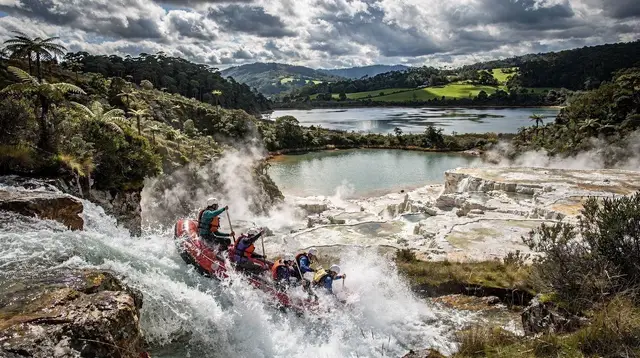
Start in Te Puia, the national institute of Māori arts and crafts and home to Pōhutu, the most reliable geyser in the Southern Hemisphere — it erupts once or twice an hour, sometimes reaching around thirty metres. Te Puia combines the geothermal valley with a working carving and weaving school, so the culture here is being practised, not displayed behind glass. A guided visit makes the difference between walking past the geysers and understanding what you’re looking at; a guided day tour at Te Puia covers the geothermal valley, kiwi conservation area and a cultural performance in one visit.
Right next to Te Puia, but run separately, is Whakarewarewa Village, where Tūhourangi Ngāti Wāhiao still live and cook using the geothermal steam rising through the ground. Reading what actually separates Te Puia from the living village before you go helps decide how to split your time between the two — many visitors do both in one morning since they sit side by side.
In the afternoon, head into town to Ōhinemutu, a Ngāti Whakaue village on the shore of Lake Rotorua with St Faith’s Church and its Christ figure etched into a window above the water. It’s a working village, not a tourist set, so keep to signed public areas. Close the day with a hāngī — a meal traditionally cooked in an earth oven, often steamed using Rotorua’s own geothermal heat. This guide to hāngī and where to eat one covers what to expect and how to choose an evening that includes a cultural performance if you want one.
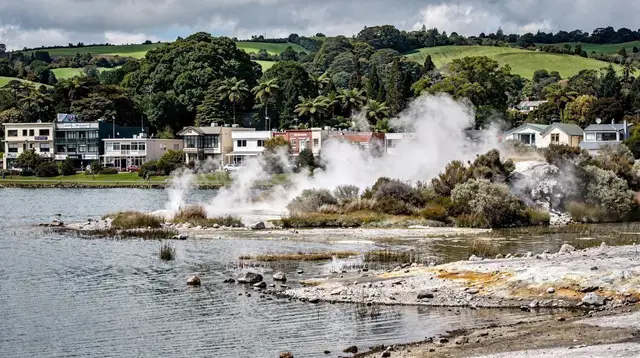
One thing that catches first-time visitors off guard on Day 1: the sulphur smell isn’t confined to Te Puia and Whakarewarewa. It drifts through parts of central Rotorua too, particularly on humid or still days, and why Rotorua smells of sulphur is worth reading before you arrive so it registers as expected rather than as something wrong with the town.
Day 2: A full day at Wai-O-Tapu
Give Wai-O-Tapu the whole day rather than a rushed afternoon. About 27 km south of Rotorua on SH5, Wai-O-Tapu is the park most visitors picture when they think of Rotorua’s geothermal landscape: the Champagne Pool’s orange rim, the Devil’s Bath, and walking tracks through steaming ground that shift colour with the mineral content of each pool. If you’re timing the visit around the Lady Knox Geyser — set off each morning at 10:15 with a surfactant rather than erupting naturally — arrive early, since that’s the one fixed point in an otherwise self-paced visit. A straightforward entry ticket to Wai-O-Tapu covers admission if you’d rather explore at your own pace after the geyser. This visiting guide breaks down walking times for each loop so you can judge how much of the day it actually needs.
If you’d rather not drive and want the day handled for you, a combined Wai-O-Tapu, Waimangu and Te Puia day tour covers transport and entries in one booking — useful if Day 1’s Te Puia visit was cut short or you want a guide narrating the geology rather than reading trail signs.
Back in Rotorua by early evening, an easy way to unwind after a day of walking on geothermal ground is a soak. Rotorua’s hot pools range from public geothermal parks to dedicated spa pools; a lakefront hot springs spa evening is a comfortable way to close a walking-heavy day, and what to know before visiting Polynesian Spa covers the practical side if that’s the one you’re considering.
Day 3: Hobbiton, then Lake Rotoiti
This is the excursion day, and it’s the one place in the itinerary where Rotorua steps aside for a few hours. Hobbiton Movie Set sits on the Alexander family farm near Matamata, about 50 minutes from Rotorua by road. The 44 hobbit holes and the Green Dragon were built as permanent structures in 2011, so what you’re walking through is a real, physical set rather than a rebuilt replica for tourists. Access is guided-only, run from the visitor centre. How to actually get from Rotorua to Hobbiton covers the transport options in more detail, and the complete Hobbiton guide is worth reading before you go so you know what the guided walk does and doesn’t cover.
A half-day Hobbiton Movie Set tour from Rotorua handles the return transfer and the guided walk through the set as one booking, which is the simplest way to fit this into a single day without worrying about parking or timed entry slots at Matamata. If you’d rather combine it with another stop on the way back, a private Hobbiton and Waitomo glowworm cave day trip adds the caves, though that makes for a considerably longer day and leaves no time for Lake Rotoiti afterwards — worth knowing before you book either option.
Back in Rotorua by mid-afternoon, spend the rest of Day 3 at Lake Rotoiti, a short drive northeast of town. Rotoiti’s hot springs are only reachable by water, which makes an afternoon on the lake genuinely different from the last two days of walking through geothermal parks on foot. Kayaking Rotorua’s lakes covers what’s realistic for a few hours without a guide, and it’s a quiet way to close a trip that’s spent most of its time on thermal ground and film sets.
Adjusting this itinerary
Three days works well as a self-contained trip, but it’s also the natural middle point between a rushed one-day visit and a longer stay. If Hobbiton isn’t a priority, the 2-day Rotorua itinerary keeps Day 1 and Day 2 above and drops the excursion day entirely. Going the other way, how many days you actually need in Rotorua walks through what a fourth or fifth day would add — typically Waimangu, Mount Tarawera, or a Tongariro Alpine Crossing day trip further south.
Weather can also change the order worth considering. If a significant rain system is forecast for Day 2 specifically, some visitors swap it with Day 3 rather than pushing through — Hobbiton and Lake Rotoiti both hold up fine in light rain, and Wai-O-Tapu is more pleasant with a full day of decent weather than a rushed one squeezed in around a storm. It’s a call worth making the evening before rather than locking the order in from home.
Rotorua 3-Day Itinerary FAQ
Can Hobbiton really fit into a 3-day Rotorua trip without cutting anything?
Yes, as a single dedicated excursion day. Hobbiton is around 50 minutes from Rotorua by road, and a half-day tour plus the drive still leaves the afternoon free for Lake Rotoiti or a quieter Rotorua stop.
Do I need a rental car for this itinerary?
It helps but isn’t essential. Wai-O-Tapu and Hobbiton are both reachable by organised tour and shuttle from Rotorua, and self-driving mainly buys flexibility on timing rather than access.
Should I book Hobbiton or Wai-O-Tapu in advance?
Both run on entry slots and group sizes that fill up, especially in summer school holidays, so booking a few days ahead is worth it rather than turning up on the day.
Is three days enough to see Rotorua’s geothermal sites properly?
It’s enough for one full geothermal park plus the geothermal walk through Te Puia, but not for Wai-O-Tapu, Waimangu and Hell’s Gate all in the same trip — this itinerary picks Wai-O-Tapu as the one excursion.
Why include Lake Rotoiti instead of another geothermal park?
After two days of thermal walking, a lake afternoon is a genuine change of pace, and Rotoiti’s hot springs are only reachable by water, which makes it a distinct experience rather than a repeat of Rotorua’s parks.
What’s the best order — Rotorua first or Hobbiton first?
Doing Rotorua’s own sites on Day 1 makes sense logistically, since Te Puia and Whakarewarewa are minutes from town, leaving the longer round trip to Hobbiton for a day when you’re already oriented.
Is this itinerary worth doing in winter?
Yes — Rotorua’s geothermal steam is more visible in cold air, and neither Wai-O-Tapu nor Hobbiton depends on warm weather to be worthwhile. The main adjustment is timing: winter days are shorter, so starting Day 3 earlier leaves enough daylight for Lake Rotoiti after the Hobbiton drive.
What happens if it rains on the Wai-O-Tapu or Hobbiton day?
Both go ahead regardless of rain and don’t offer refunds for weather alone. Wai-O-Tapu’s boardwalks stay open and the steam is often more visible in wet conditions, and Hobbiton’s guided walk continues rain or shine, with shelter available at the visitor centre.
tours.3 days
Verified deep-linked GetYourGuide tours. Book through these links and we earn a small commission at no cost to you.
Photos show the destination, not the operator's own images.