Free Hot Springs Around Rotorua: What's Actually Free
Are there really free hot springs near Rotorua?
Yes, but the genuinely free list is short: Kerosene Creek, the nearby Hot and Cold Stream, and Te Rata Bay on Lake Rotoiti, which is only free if you arrive by your own kayak or boat. All three are unpatrolled, with no facilities, and carry a real amoeba risk if water goes up your nose.
The free hot springs that actually exist near Rotorua
Rotorua sits inside an active geothermal field, so hot water reaches the surface in more places than the parks that charge for it. That fact gets stretched online into the idea that free hot pools are scattered all over the region. They are not. The genuinely free, publicly reachable list is short and specific: Kerosene Creek, the smaller Hot and Cold Stream nearby, and Te Rata Bay on Lake Rotoiti, which is free only in the sense that no one charges you at a gate — getting there is its own project. This guide covers what each of these actually is, what “free” leaves out, and the two risks that matter more than the ones people usually ask about first: an amoeba you cannot see, and a car park you cannot watch while you soak.
None of this is a case against visiting. It is a case for knowing exactly what you are opting into when you skip the paid, staffed geothermal parks in favour of a gravel road and a stream.
Kerosene Creek
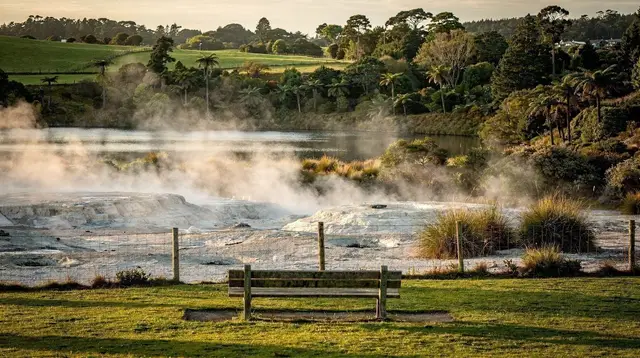
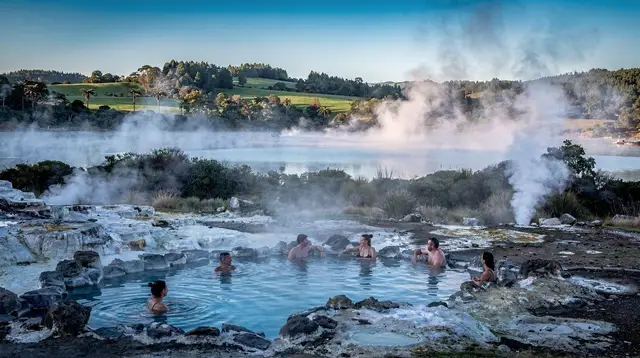
Kerosene Creek is off State Highway 5, on the same stretch of road that leads south toward Wai-O-Tapu, down a short gravel side road. A wooden platform and a short streamside walk lead to a small waterfall that drops into a natural pool warmed by geothermal inflow. There is no ticket booth, no gate, and no staff. It is genuinely free.
It is also genuinely unpatrolled. There are no toilets, no rubbish bins, no lifeguard, and no one checking the water on a schedule the way a commercial park would. The smell of sulphur is part of the experience here, not a fault — it is the same hydrogen sulphide that explains why Rotorua smells the way it does across the wider region. Weekends and late afternoons draw a steady stream of visitors, and the small pool and single waterfall mean it rarely feels empty.
Hot and Cold Stream
A short distance from Kerosene Creek, and easy to conflate with it, is Hot and Cold Stream — a spot where a geothermally heated trickle meets an ordinary cold stream, so the temperature you get depends on exactly where in the flow you settle. It shares the same character as Kerosene Creek: gravel access, no facilities, no supervision, and a strong sulphur note in the air. Fewer people know about it, which is its main appeal and also the reason there is even less on-site information if something goes wrong. The broader geothermal safety guide for Rotorua is worth reading before either spot, since neither has anyone on hand to help if something goes wrong.
Treat the two as a pair rather than a single destination. If Kerosene Creek’s car park is full, this is usually where the overflow goes.
Te Rata Bay, Lake Rotoiti
Lake Rotoiti has natural hot pools right at the water’s edge on part of its shoreline, and Te Rata Bay is the free end of that story. The commercially run Manupirua Springs sit on the same general shoreline, reached by a paid boat shuttle with changing facilities and a maintained pool. Te Rata Bay has no such infrastructure and no fee for the water itself — but the lake has no road access at that point, so reaching it means arriving by kayak or your own boat.
That makes “free” a relative term. If you already have a kayak, or you’re comfortable paddling a rented one across open water, the pool costs nothing. If you don’t, the realistic free option is a guided kayak trip that takes you there and back, which is not free in the way Kerosene Creek is, but is a genuinely different kind of soak — arrived at by water, on a lakeshore, rather than off a highway.
a guided kayak paddle out to natural lakeside hot springs covers this exact gap: it removes the need to own or transport a kayak and adds someone who knows the current conditions of the water.
What “free” doesn’t include
Skipping the entry fee at a paid geothermal park does not just remove a cost. It removes everything the fee pays for:
- No lifeguards or staff. If something goes wrong — a slip on wet rock, a child struggling, someone feeling faint in the heat — you are the emergency response.
- No facilities. No toilets, no changing rooms, no showers, no rubbish collection. Whatever you bring in, you carry back out.
- No temperature control. These are natural flows, not managed pools. Heavy rain can dilute the heat to lukewarm within a day; dry spells can leave sections uncomfortably hot near the source.
- No routine water testing. A paid facility such as the Polynesian Spa manages water quality on a schedule. A free creek does not, and conditions can change after storms or upstream events without any signage updating.
- No guarantee of access. Conditions, land arrangements, or safety advisories can close a site with little notice. There is no booking to refund and no official channel that always tells you before you drive out.
None of this makes these places unsafe by default. It means the margin for things going wrong is thinner, and the responsibility for managing that margin sits entirely with you.
The risk that matters more than most people expect: amoeba in warm water
This is the part of the free-hot-springs conversation that gets skipped in favour of photos of the waterfall, and it shouldn’t be. Warm, untreated freshwater in geothermally active regions — the kind found in streams like these, not in properly chlorinated pools — can carry Naegleria fowleri, a naturally occurring microorganism. It does not cause illness if swallowed or if it touches skin. The danger is specific: if warm water carrying it is forced up the nose, it can travel to the brain and cause a very rare but almost always fatal infection.
New Zealand health authorities have issued public warnings about this risk for exactly the kind of natural warm-water sites this guide describes. The practical response is straightforward and does not require avoiding the water altogether:
- Keep your head above the surface. Don’t duck, dive, or dunk.
- Don’t jump or cannonball into pools where water could be forced up your nose.
- Watch children closely — they are the group most likely to submerge without thinking about it, and most likely to end up with warm water forced up the nose while playing.
- If you’re uneasy about controlling this, a nose clip removes the guesswork entirely.
- Avoid stirring up sediment at the bottom of a pool, where warmer, stagnant pockets tend to sit.
If you’re travelling with young children, the guide to Rotorua with kids covers this and other safety trade-offs worth weighing before choosing an unsupervised spot over a staffed pool.
This is not a reason to skip Kerosene Creek. It is a reason to treat “keep your head up” as a rule you actually follow, not a line you read once and forget once you’re in warm water on a cold day.
The other real risk: your car, not the water
The second thing worth being blunt about has nothing to do with geothermal chemistry. These free spots share a pattern: a gravel pull-in beside a quiet road, no attendant, and a queue of vehicles sitting empty while their owners are down at the water for twenty minutes to an hour. That is a predictable target, and vehicle break-ins at exactly this kind of unpatrolled trailhead car park are common enough around Rotorua that they should be planned for, not treated as bad luck.
The fix is unglamorous and effective:
- Leave nothing visible on seats or in footwells — bags, jackets, and chargers all read as “something might be in there.”
- Take your wallet, phone, and passport with you rather than leaving them in the car, even in a locked boot.
- Park considerately on the gravel shoulder; these roads are narrow and shared with local traffic and residents.
- Don’t leave a rental car at one of these car parks overnight.
Rental car insurance in New Zealand routinely excludes theft from an unattended vehicle where nothing shows obvious forced entry, so the financial consequence of ignoring this can land entirely on you.
Free hot springs at a glance
| Spot | Access | Facilities | Main risk to manage |
|---|---|---|---|
| Kerosene Creek | Gravel side road off SH5, short walk | None | Amoeba (head under water); car park theft |
| Hot and Cold Stream | Gravel side road near Kerosene Creek | None | Same as above, plus less signage/info on site |
| Te Rata Bay (Lake Rotoiti) | Kayak or private boat only | None | Water safety on the lake; no free option without a craft |
Free versus paid: when the fee is worth paying
None of this is an argument against the free spots. It is an argument for choosing them for the right reasons — the setting, the natural feel, the cost — rather than assuming they’re a straight substitute for a managed geothermal pool. A staffed, maintained facility buys you things a stream cannot: graded pool temperatures, lifeguards or attendants, changing rooms and showers, and in several cases cultural context delivered by people who know the land. The Rotorua hot pools guide covers the full spread of paid options if you want to compare properly. For a different natural-but-managed soak, the guide to Rotorua’s mud baths and mud pools sits between the two extremes.
If you’re travelling with young children, have limited mobility, or would simply rather not manage water-safety decisions alone in an unpatrolled setting, that trade is usually worth making. A lakefront option built around managed pools and guided Māori wellness practice — a lakefront hot springs spa experience with guided Māori wellness elements — sits at the opposite end of the spectrum from a gravel car park, with staff, facilities, and no amoeba question to think about. A shorter, lower-cost middle ground is a guided afternoon tour through a geothermal thermal area, which adds supervision and interpretation without the full spa price tag.
If you’d rather combine a hot soak with an activity instead of a park, a rafting and zipline day that finishes at a hot pool with a free sauna bundles transport, supervision, and a managed pool into one booking — useful if driving gravel roads on the left isn’t something you’re confident doing.
Etiquette that keeps these places open
Free access is not guaranteed access, and free sites have closed elsewhere in New Zealand after damage, overcrowding, or repeated disrespect. A short list of what keeps that from happening here:
- No soap, shampoo, or sunscreen in the water — these are natural streams, not treated pools, and residue affects everyone downstream.
- No glass and no littering. Pack out everything you bring in, including anything left behind by someone else if you’re willing.
- Keep noise down, particularly in the evening — people live near both Kerosene Creek and Hot and Cold Stream, and late-night groups are the most common source of complaints.
- Respect any signage about temporary closures. These can follow storm damage, water-quality concerns, or land-access changes, and they’re posted for a reason even without a permanent gate to enforce them.
This lines up with the wider Tiaki Promise that New Zealand asks of every visitor: leave the place in the same or better state than you found it. It’s the same principle behind Rotorua’s other free things to do — access without cost still comes with responsibility.
Practical checklist
- Footwear you can walk in wet: rocks around geothermal streams are uneven and often slippery, and going barefoot is a common cause of minor injury at both Kerosene Creek and Hot and Cold Stream.
- A towel and dry clothes, since there is nowhere to change.
- Drinking water, especially in summer when the UV index runs high even on a cool day.
- A bag for your own rubbish — there are no bins at either site.
- Small cash, in case a local donation box is present; this varies and isn’t guaranteed.
- No alcohol before or during a soak. Combining heat and alcohol increases the risk of dizziness or fainting in water you’re managing without a lifeguard.
Getting there
Both Kerosene Creek and Hot and Cold Stream sit off State Highway 5 south of Rotorua, reached by gravel side roads that are straightforward in a car but slower and rougher than the highway. If you’re not confident with driving in New Zealand — left-hand side of the road, narrow shoulders, gravel surfaces — or you’re getting around Rotorua without a car, a guided option that includes hot pool access removes that question entirely, along with the car park risk described above.
Te Rata Bay has no road access at all; it’s reached by paddling or boating across Lake Rotoiti, which the guides above cover in more detail if you want to plan that route independently rather than joining a tour. These two roadside springs also slot easily into a two-day geothermal itinerary built around Rotorua’s parks and pools.
Kerosene Creek and other free hot springs: FAQ
Is Kerosene Creek really free to visit?
Yes. There is no entry fee, gate, or ticket booth. It is reached by a short walk from a gravel car park, with no staff, toilets, or rubbish bins on site.
Where are Kerosene Creek and Hot and Cold Stream in relation to each other?
They sit close together off the same stretch of State Highway 5 south of Rotorua, on the way toward Wai-O-Tapu. Hot and Cold Stream is the smaller, less-visited spot where a hot geothermal trickle meets a cold stream, so the temperature depends on exactly where you sit.
Is Te Rata Bay actually free?
Only if you get there under your own power, by kayak or private boat, across Lake Rotoiti. The nearby Manupirua Springs on the same shoreline are commercially operated with a paid boat shuttle. Te Rata Bay itself has no gate, but reaching it is not free in effort or, usually, in gear hire.
Is it safe to put your head under the water at these springs?
No, and this is not a minor caution. Warm, untreated freshwater in geothermal areas can carry Naegleria fowleri, a microorganism that causes a rare but almost always fatal brain infection if forced up the nose. Keep your head above water, do not dive or jump in, and do not let children submerge or splash water up their nose.
Do people really get their cars broken into at these car parks?
It happens often enough that it is treated as an ordinary risk of visiting, not a rare exception. The car parks are gravel pull-ins on a quiet road, unpatrolled, with vehicles visibly empty for the time it takes to walk down and soak. Leave nothing on view and take valuables with you.
What should I bring to Kerosene Creek or Hot and Cold Stream?
Swimwear, a towel, footwear you can walk on slippery rock and uneven geothermal ground in, drinking water, and a bag to carry your own rubbish back out. There are no changing rooms, no lifeguards, and no bins.
Are the free hot springs open all year, including after rain?
There is no gate to open or close, but flow and temperature shift with rainfall and season, and heavy rain can turn a hot pool lukewarm or muddy for a day or two. Local operators and the Department of Conservation are better placed than any fixed schedule to confirm current conditions.
What is the alternative if I don’t want to self-drive to a gravel car park?
A guided tour that includes a natural hot pool or spring as part of a supervised itinerary removes the driving, parking, and solo-safety questions, at the cost of the pool no longer being free. Options range from a short thermal-area walk to a full day combining adventure activities with a hot pool finish.
Hot pools & spa experiences in Rotorua
Verified deep-linked GetYourGuide tours. Book through these links and we earn a small commission at no cost to you.
Photos show the destination, not the operator's own images.