Polynesian Spa: Priest and Rachel Pools, Deluxe vs Pavilion vs Family
What is the difference between the Priest and Rachel pools at Polynesian Spa?
Priest Spring water is acidic and sulphurous, drawn from a spring named after a 19th-century priest who reportedly found relief there for arthritis. Rachel Spring water is alkaline and softer on the skin, named after Rachel, a legendary figure associated with the site. Both feed a series of terraced pools at slightly different temperatures on the shore of Lake Rotorua.
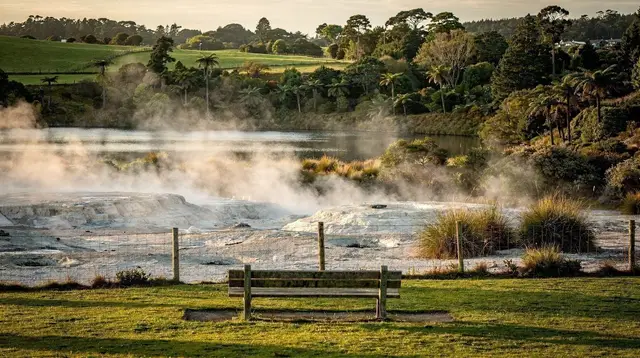
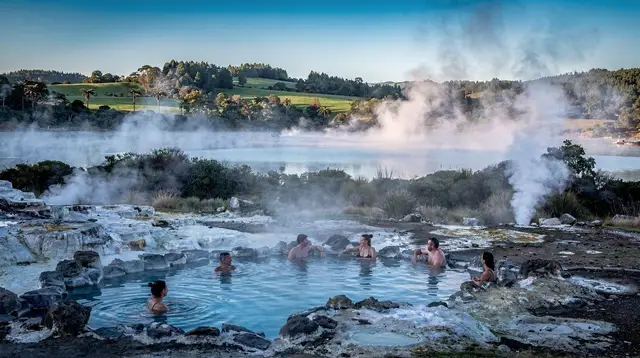
Polynesian Spa sits on the shore of Lake Rotorua, on the edge of the Government Gardens, at a spot where two distinct geothermal springs surface within a short walk of each other. That accident of geology is the reason the complex is split into named pool areas rather than one generic hot pool, and it is also why the choice between Deluxe, Pavilion and Family is not just about price. Each area draws on different water, allows different ages, and suits a different kind of visit. This guide works through the two springs, the three pool categories, and when in the day to go.
If you are still deciding whether a soak here fits your itinerary at all, see the wider Rotorua hot pools guide, which compares Polynesian Spa against other commercial and free options. This page assumes you have already decided on Polynesian Spa and need to choose which part of it.
Priest Spring and Rachel Spring: two different waters
Polynesian Spa did not invent its hot water; it was built around two natural springs that already had reputations before the facility existed. Understanding which spring feeds which pool explains most of the practical differences on site.
Priest Spring is acidic. The name comes from a 19th-century Catholic priest, Father Mahoney, who is said to have found relief from arthritis in the water and whose story helped establish the site’s reputation as a place people travelled to for its water, not just to look at it. Priest water carries a distinct sulphurous edge, the same hydrogen sulphide smell that hangs over much of central Rotorua (covered in more detail in why Rotorua smells of sulphur), and it is markedly stronger to the nose than the other pools on site. The Priest terraces step down through several pools, each a few degrees apart, so you can move from a hotter upper pool to a milder one lower down rather than committing to a single temperature.
Rachel Spring is alkaline, softer on the skin, and named after a figure associated with the spa’s early history and mythology rather than a documented individual in the way Father Mahoney is. Rachel water lacks the strong sulphur edge of the Priest side, which is part of why it is paired with the more comfortable, longer-soak areas of the complex. If the smell of the Priest pools is not for you, or you are sensitive to strong odours, the Rachel side is the more forgiving choice.
Both springs are geothermal, both are naturally hot rather than heated artificially, and both are part of the same wider system responsible for the geysers and mud pools elsewhere in town — the same underlying geothermal parks draw on this system a short drive away, just without the developed terraces.
| Spring | Character | Typical use on site |
|---|---|---|
| Priest | Acidic, sulphurous, historically linked to arthritis relief | Adult terraces, Pavilion and part of Deluxe |
| Rachel | Alkaline, milder smell, gentler on skin | Adult terraces, part of Deluxe and Pavilion |
Deluxe, Pavilion and Family: what actually separates them
The three named categories are not simply “budget, mid-range, premium” versions of the same pools. They differ in who can use them, how many other people you will share the water with, and which spring feeds them.
Pavilion
Pavilion is the standard adult offering: a set of lake-view mineral pools at varying temperatures, open to guests aged roughly 12 and up. This is the area most day visitors book, and it is the one that gives the clearest sense of the site’s setting — several of the pools look directly out over Lake Rotorua. Expect more people in the water than in the Deluxe section, particularly through the middle of the day.
a Pavilion session for adults and older children is the entry point most first-time visitors choose, and it is a reasonable way to try the springs before deciding whether a return visit to the smaller Deluxe pools is worth it.
Deluxe Lake Spa
Deluxe is a smaller, adults-only section set closer to the water’s edge, with fewer pools per bather and a quieter, more private feel than Pavilion. It draws on the same two springs but in a more contained layout, which is the main reason it costs more: you are paying for space and lower density, not for different water. Because capacity is limited, Deluxe pools are the ones most likely to be fully booked on short notice, especially in summer and on weekends.
a Deluxe Lake Spa session suits a couple or a quiet visit better than a family day out, given both the adult-only rule and the smaller pool sizes.
Family
Family is the only category that admits children, and it is paired with a freshwater pool rather than the acidic Priest water used elsewhere on site. This is a deliberate separation: the strongly sulphurous, acidic water in the adult terraces is not considered suitable for young children, so the Family area draws on milder mineral water alongside a standard freshwater pool for straightforward swimming and play. If you are travelling with children under the adult-pool age minimum, this is the only part of Polynesian Spa open to your family as a group — see Rotorua with kids for how it fits into a wider family itinerary.
a Family hot pools and freshwater pool session is the option to book if anyone in your group is under the adult-pool age limit, since the Pavilion and Deluxe areas will otherwise turn away younger children at the gate.
A private alternative away from the main complex
If the idea of shared pools, even the quieter Deluxe ones, is not appealing, a private hot tub away from the main Polynesian Spa complex is worth considering as an alternative rather than a substitute. a private cedar hot tub soak gives a similar geothermal-adjacent soak without sharing water with strangers, though it is a different setting entirely rather than another way to access Priest or Rachel water.
| Category | Water | Who can use it | Feel |
|---|---|---|---|
| Pavilion | Priest and Rachel mineral water | Adults and older children (commonly 12+) | Standard, lake-view, busier |
| Deluxe Lake Spa | Priest and Rachel mineral water | Adults only | Smaller pools, quieter, lakefront |
| Family | Milder mineral water plus freshwater | All ages, including young children | Freshwater pool included, no strong sulphur pools |
When to go: reading the daily pattern
Polynesian Spa sits close to the town centre and to the cruise-ship shuttle routes from Tauranga, which means its busiest hours track the arrival pattern of day-tour groups rather than a fixed peak time. Mid-morning through mid-afternoon is when coach groups and cruise-day visitors are most likely to be on site, alongside independent travellers who have just finished breakfast and are working through a checklist of Rotorua sights before lunch.
Two windows tend to be quieter:
- Early morning, at or close to opening, before day-tour schedules bring groups in. This is also often the calmest water, before repeated use by many bathers.
- Evening, particularly the last couple of hours before closing. In winter this is the more atmospheric option: the contrast between hot water and cold night air makes the steam far more visible, and the lake view shifts from daylight to dusk or dark depending on the season and how Rotorua’s seasons affect sunset timing.
Because Rotorua’s climate delivers rain across the whole year rather than in a single wet season, a rainy afternoon is not a reason to avoid Polynesian Spa — soaking in hot water while it rains is one of the more comfortable ways to spend a wet day, and it is a reasonable pivot if an outdoor plan gets rained out; see Rotorua rainy-day activities for other options that pair well with it.
Weekends and New Zealand and Australian school holiday periods add pressure on top of the daily pattern, particularly for the smaller Deluxe pools. Booking ahead rather than turning up and hoping for space is the more reliable approach, especially outside the shoulder of the day.
Combining a visit with the rest of Rotorua
Polynesian Spa works well as a bookend to a day rather than the centrepiece of one, since a soak is more comfortable after activity than before it. A common pattern is a morning at one of the geothermal parks — Te Puia, Whakarewarewa Village or Wai-O-Tapu — followed by an afternoon or evening soak once the walking is done. Another is to pair it with a visit to Ōhinemutu or the Government Gardens next door, both a short walk from the spa itself.
For travellers without a rental car, Polynesian Spa’s central location makes it one of the easier hot-pool experiences to reach without driving — see getting around Rotorua without a car for how a taxi, shuttle or short walk from town compares to the more remote options like the free hot springs around Rotorua, several of which require a vehicle.
Budget-wise, Polynesian Spa sits closer to the mid-range end of a Rotorua day rather than the free end. For context on how a soak here fits into a broader daily spend, see Rotorua on a budget; as a general reference point, a mid-range daily budget in Rotorua runs in the region of 350 NZD per person including accommodation and meals, and a soak is a modest addition to that rather than a major line item on its own. Exact current pricing for each pool category is set by the operator and is best confirmed at the time of booking rather than assumed from an earlier visit.
A note on what the pools are not
It is worth being clear about scale and expectations here. Polynesian Spa is a developed, commercial bathing complex with built terraces and staffed facilities, not a wild or free geothermal feature. If what you are picturing is a natural pool in the open landscape with no infrastructure, that experience exists elsewhere around Rotorua and Lake Rotoiti rather than here — see free hot springs around Rotorua for that alternative, and Rotorua mud baths and mud pools if mud rather than clear water is what you are after. Polynesian Spa’s value is the reverse: reliable, maintained pools fed by genuine geothermal springs, with the choice of Priest or Rachel water and the option to scale privacy and price up through Pavilion to Deluxe, or down to the family-friendly freshwater option if children are travelling with you.
Frequently asked questions about Polynesian Spa’s pools
What is the difference between the Priest and Rachel pools at Polynesian Spa?
Priest Spring water is acidic and sulphurous, historically linked to relief from arthritis and rheumatism. Rachel Spring water is alkaline and gentler on skin. The Priest terraces and the Rachel terraces sit in different parts of the complex, each stepping down through several pools at slightly different temperatures.
What is the difference between Deluxe, Pavilion and Family at Polynesian Spa?
Pavilion is the standard adult area with lake-view mineral pools. Deluxe Lake Spa is a smaller, adults-only section with private-feeling pools closer to the water and fewer people per pool. Family is the area that welcomes children, paired with a freshwater pool, and it does not draw on the same acidic Priest water as the adult terraces.
Is Polynesian Spa suitable for children?
Only the Family pools and the freshwater pool are open to children. The Pavilion and Deluxe adult pools have a minimum age, commonly cited as 12 and up, so a family with younger children should plan around the Family area rather than the adult terraces.
What is the best time of day to visit Polynesian Spa?
Early morning, at or shortly after opening, and late evening tend to be quieter, since day-tour groups and cruise-ship visitors typically arrive mid-morning through mid-afternoon. Winter evenings add the contrast of steam rising off hot water into cold air, which is part of the experience.
Do I need to book Polynesian Spa in advance?
Booking ahead is strongly advisable, particularly for the Deluxe Lake Spa pools and at peak times such as summer weekends and school holidays, since capacity in the smaller adult sections is limited. Walk-ins are not guaranteed a spot.
Does the water at Polynesian Spa smell of sulphur?
The Priest Spring side does, since it draws on acidic geothermal water containing hydrogen sulphide, the same compound behind Rotorua’s general sulphur smell. The Rachel Spring side and the Family freshwater pool are noticeably milder.
How long should I plan to spend at Polynesian Spa?
Most visitors spend one to two hours moving between a few pools of different temperatures, with rest breaks in between. A late-afternoon or evening visit combined with an early dinner nearby is a common way to fit it around a day of geothermal sightseeing.
Is Polynesian Spa the same as a free hot spring?
No. Polynesian Spa is a developed, commercial facility with built terraces, changing rooms and staff. Free or low-cost natural hot springs exist elsewhere around Rotorua and Lake Rotoiti, but they are separate sites with none of the infrastructure.
Hot pools & spa experiences in Rotorua
Verified deep-linked GetYourGuide tours. Book through these links and we earn a small commission at no cost to you.
Photos show the destination, not the operator's own images.