How to Pronounce New Zealand Place Names
The Word I Kept Getting Wrong
I said Whakarewarewa out loud for the first time in a car park in Rotorua, badly, and the woman selling tickets corrected me without missing a beat: not “wack-a-ruh-wuh-ruh-wuh”, but something closer to fah-kah-reh-wah-reh-wah, each vowel its own small step. I had been mentally filing the wh as a w for years, the way you do with a word you have only ever read. It took about four names, and four small corrections, before the pattern clicked. This is that pattern, written down the way I wish someone had handed it to me before I got out of the car.
The wh Sound Is Not a W
The single biggest fix, and the one that unlocks almost every other name on this coast, is the wh. In most of the North Island, Whakarewarewa is said with an f sound, not a w: fah-kah-reh-wah-reh-wah. The same rule gives you Whakatāne as fah-kah-tah-neh, and it is why the town’s name never sounds anything like “wack-a-tarn”. There are pockets of the country, and some older speakers, who use a softer breathy w instead of the f, but as a visitor you will not go wrong defaulting to f. It is what most guides at Whakarewarewa village and the wider Te Arawa area actually say.
Once the wh stops being a trap, a lot of names on a Rotorua map stop looking intimidating and start looking like they are just spelled out phonetically, which, once you know the rules, they mostly are.
Vowels Do the Real Work: Ngongotahā, Taupō, Rotorua
English speakers tend to slide vowels together and swallow the ones in the middle of a word. Māori does the opposite: every vowel is said clearly and on its own, one after another, never blended. That is the whole trick behind a name like Ngongotahā, which becomes much less alarming once you break it into noh-ngoh-toh-hah rather than trying to say it as one lump. The ng in the middle is a single soft sound, closer to the ng in “singer” than to a hard g, and it shows up again in words like Ngāti, the prefix for a Te Arawa tribal group.
Then there is the macron, the small line you will see over letters in Taupō, Whakatāne, Pāpāmoa or Karāpiro. It does not change the vowel, it lengthens it: you hold the sound a beat longer than an unmarked vowel. Taupō is tah-oo-poh, with that final o held slightly. It is not decoration, and in a language with real minimal pairs, dropping it is not neutral: it can change what the word actually means. That is one reason this site keeps macrons on names like Taupō and Ngongotahā and drops them only where the settled local spelling drops them too, as with Rotorua, Mount Tarawera and Whakarewarewa. It is not a fully consistent rule across the country, but it is the one Rotorua itself uses.
Names That Trip Almost Everyone Up
A short list of the names visitors around Rotorua ask about most, with a rough phonetic guide rather than strict linguistics:
| Written | Rough sound | Where |
|---|---|---|
| Whakarewarewa | fah-kah-reh-wah-reh-wah | Thermal village and forest |
| Whakatāne | fah-kah-tah-neh | Bay of Plenty town |
| Ngongotahā | noh-ngoh-toh-hah | Suburb and mountain near Rotorua |
| Taupō | tah-oo-poh | Lake and town south of Rotorua |
| Ōhinemutu | oh-hee-neh-moo-too | Lakeside Ngāti Whakaue village |
| Rotoiti | roh-toh-ee-tee | Neighbouring lake |
| Hamurana | hah-moo-rah-nah | Springs at the lake’s north end |
Worth saying plainly: Hobbiton is not a Māori name at all, and it is not in Rotorua either. It sits on a farm near Matamata, roughly fifty minutes away, which is a separate mix-up from pronunciation but one I hear almost as often. If a set tour is on the list anyway, a day trip to the Hobbiton Movie Set from Rotorua covers the drive and the naming confusion in one go.
Why It Actually Matters Here
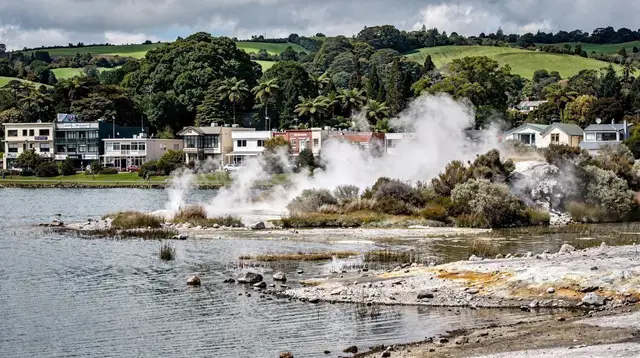
This is not pedantry for its own sake. Around Rotorua, a place name is very often also a person’s name, an ancestor, or a short version of a longer story: Te Arawa’s history is written into the map, not layered on top of it afterwards. Ōhinemutu, the lakeside village where Ngāti Whakaue still live, is not a museum piece, and neither is the geothermal valley at Whakarewarewa, where people cook with the steam that also drives the tourism. Getting a name roughly right, or at least trying audibly, is a small signal that you understand you are a guest in a place people actually live, the same idea behind the cultural etiquette that governs things like the haka or how a hāngī is treated.
I noticed the difference myself on a walk through the thermal valley on an afternoon eco-thermal tour, when the guide paused on a geyser’s name and asked, lightly, whether anyone wanted to try saying it back. Nobody got it perfect. Nobody was expected to. But the ones who tried got a longer, better answer than the ones who laughed it off.
The same goes further out. At Waimangu, whose name means black water and refers to the lake formed after the 1886 eruption, or on a Wai-O-Tapu and Waimangu valley tour, the names are not random labels: wai means water, and it turns up again in Waitomo, Waikato and dozens of other names once you know to listen for it. So does the buried settlement at Te Wairoa, whose story is tied directly to Tarawera’s 1886 eruption; a guided visit to the Buried Village of Te Wairoa is one of the more direct ways to hear the name explained alongside the history behind it.
A Few Rules I Wish I’d Known Before the Car Park
- Say wh as f, not w: Whakarewarewa, Whakatāne, Whakaari.
- Say every vowel on its own, never blended: break long names into short syllables.
- A macron lengthens a vowel, it does not change it: Taupō, not “Tarpo”.
- Ng is one soft sound, like “singer”: Ngongotahā, Ngāti.
- Wai means water and shows up everywhere: Waimangu, Waitomo, Waikato.
- When in doubt, ask. Nearly everyone I met, from ticket counters to guides on the Rotorua Māori culture itinerary, was glad to correct a genuine attempt.
None of this makes you fluent, and it is not meant to. It just means that by the time you are standing at Whakarewarewa or driving toward Whakatāne, the names on the signposts stop being noise and start being words with a shape you can actually hold onto.
FAQ: Pronouncing Māori Place Names Around Rotorua
Is wh always pronounced as f in Māori place names?
In most of the North Island, including around Rotorua, yes: wh is said as a soft f. A handful of areas and older speakers use a softer breathy w instead, but f is the safe default for a visitor and what you will hear from most guides.
What does a macron over a vowel actually mean, as in Taupō or Whakatāne?
A macron, the small line over a letter such as ā, ē, ī, ō or ū, means the vowel is held longer. It does not change the vowel’s basic sound, and dropping it is not just a spelling choice: it can change the word’s meaning.
Why is there no macron on Rotorua but there is one on Taupō?
Convention has settled differently for different names. Rotorua, Tarawera, Waitomo and Whakarewarewa are commonly written without macrons even in careful modern usage, while Taupō, Whakatāne and Ngongotahā keep theirs. Following current local spelling is the practical rule, since it is not fully systematic.
How do you say Ngongotahā?
Roughly noh-ngoh-toh-hah, with every vowel pronounced on its own and the final ā held slightly longer. The ng combination is a single soft sound, closer to the ng in singer than to a hard g.
Do locals mind if visitors mispronounce Māori place names?
Most people are patient with a genuine attempt and far less patient with someone who refuses to try. Te Arawa culture around Rotorua is lived, not performed for tourists, and a place name is usually also a person’s name, an ancestor, or a story, so a rough but sincere attempt is read very differently from a shrug.
Is it true that Māori vowels never combine like English ones do?
Yes. Each vowel keeps its own short, clean sound and is pronounced in turn rather than blended, which is why breaking a long name into syllables, as in Wha-ka-re-wa-re-wa, works better than trying to say it as one English-style word.
Lake cruises on GetYourGuide
Verified deep-linked GetYourGuide tours. Book through these links and we earn a small commission at no cost to you.
Photos show the destination, not the operator's own images.