Two Days of Māori Culture Around Rotorua
Two days is enough to move past the geysers and into who lives with them. This itinerary keeps the geothermal parks in the background and puts the Te Arawa villages, the national arts institute, and the site of the 1886 eruption in front. No car, no cultural evening built in by default — just four places, in an order that respects how close together they actually sit.
Why a village and an institute aren’t the same stop
Whakarewarewa Village and Te Puia share the same thermal reserve on the edge of Rotorua, and it’s easy to assume they’re one attraction split into two ticket booths. They aren’t. Whakarewarewa is a residential settlement of Tūhourangi Ngāti Wāhiao — steam boxes cook food in front yards, and the guides who take you through are usually showing you their own street. Te Puia is a training institution: the New Zealand Māori Arts and Crafts Institute, where apprentice carvers and weavers work through structured programmes, and where Pōhutu geyser erupts on the same reserve. This guide goes through the distinction in more detail if you want to decide which one to prioritise.
Day two moves into town and out of it again: Ōhinemutu, a Ngāti Whakaue village on the shore of Lake Rotorua that most visitors drive past without noticing, and the Te Wairoa Buried Village, where the ground itself is the exhibit.
Day 1: Whakarewarewa Village and Te Puia
Morning — Whakarewarewa Village
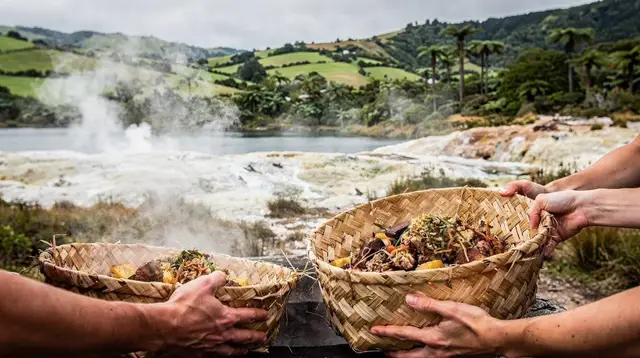
Start at Whakarewarewa Village, reachable by taxi or local bus from central Rotorua in a few minutes. This is the “living village” — Tūhourangi Ngāti Wāhiao families still occupy the houses along the geothermal terraces, and geothermal steam still does real cooking here, not a demonstration of it. A guided walk through with a local guide, such as the Rotorua Whakarewarewa Village guided tour, covers the history of the settlement, the mechanics of steam cooking, and the small geyser field within the village boundary. If you’d rather set your own pace, the self-guided geothermal trails at Whakarewarewa let you walk the terraces on marked paths without a fixed schedule.
Give this stop one and a half to two hours. It’s compact, but it rewards slowing down rather than moving through quickly — the point of visiting a village is noticing that it’s one.
Afternoon — Te Puia
Te Puia sits immediately next to Whakarewarewa on the same thermal reserve, so the transition is a short walk or a two-minute taxi hop. This is the national institute for Māori arts and crafts: working carving and weaving schools open to visitors, a reconstructed pre-European village, a kiwi conservation enclosure, and Pōhutu geyser, the most reliable geyser in the southern hemisphere, erupting once or twice an hour. The Te Puia Te Rā guided day tour combines the geothermal valley with the carving school and a cultural performance if you want the fuller version of the site; a shorter self-timed visit works if you’re mainly here for the geyser and the institute itself.
Plan on two to three hours at Te Puia. Between the two stops, day one runs roughly five hours of actual visiting time, which leaves the rest of the day free — Kuirau Park or the Government Gardens are both close to town if you want a low-key geothermal walk to close the day, or see rainy-day options if the weather turns, which in Rotorua it does year-round.
Day 2: Ōhinemutu and Te Wairoa Buried Village
Morning — Ōhinemutu
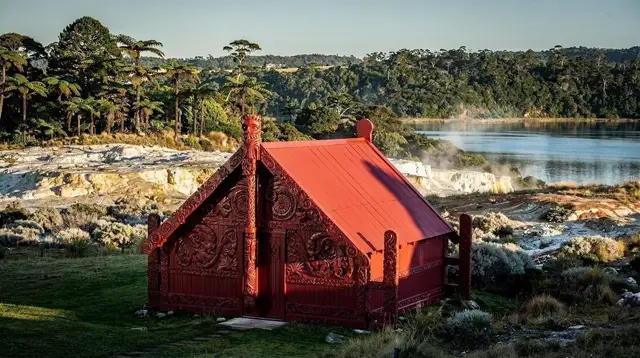
Ōhinemutu is a genuine oddity: a Ngāti Whakaue village sitting inside Rotorua’s town boundary, on the shore of Lake Rotorua, that most itineraries skip because it isn’t gated or ticketed. It’s a short walk or taxi from the town centre. The carved meeting house and St Faith’s Anglican church are the two landmarks — St Faith’s has an etched-glass window of Christ that appears, from inside, to be walking on the lake outside. This is a working village where tangihanga and other ceremonies take place; visitors are welcome to walk through respectfully, keep to public paths, and be mindful that it’s someone’s home, not a stage set.
An hour is usually enough for Ōhinemutu itself, though it’s worth pairing with a slow walk along the lakefront rather than rushing straight to the next stop.
Afternoon — Te Wairoa Buried Village
Te Wairoa Buried Village is about 15 km from central Rotorua, on the way to Lake Tarawera — the one stop in this itinerary that falls outside comfortable walking or short-taxi range, so a shuttle, tour, or booked transfer is the practical option if you’re not driving. The Rotorua Buried Village of Te Wairoa tour handles the return trip and includes entry to the excavated site.
Te Wairoa was a mixed Māori and European settlement built to service tourists visiting the Pink and White Terraces — until the Tarawera eruption of 10 June 1886 buried it in ash and ended the terraces as a destination entirely. What’s excavated today is a walkable site of building foundations, a small museum, and a waterfall walk down to the original village well. It’s a somber counterpoint to the geothermal parks: the same volcanic system that produces Pōhutu and the Waimangu landscape also did this, in living memory relative to the region’s tourism history. Allow two hours on site, plus travel.
Getting between the four stops without a car
| Leg | Distance from central Rotorua | Typical option |
|---|---|---|
| Whakarewarewa Village | ~3 km | Taxi, rideshare, or local bus |
| Te Puia | Adjacent to Whakarewarewa | Short walk or taxi |
| Ōhinemutu | Inside the town boundary | Walk or short taxi |
| Te Wairoa Buried Village | ~15 km | Taxi, shuttle, or tour with transfer included |
If you’d rather not arrange taxis for each leg separately, the Rotorua Eco Thermal Afternoon Tour bundles transport with a guided geothermal stop and can slot into either afternoon depending on availability. See getting around Rotorua without a car for the wider picture of buses, taxis, and shuttle operators in town.
What this itinerary leaves out, deliberately
There’s no cultural evening or hāngī dinner built into these two days by default. That’s a separate decision — see hāngī: what it is and where to eat one and Rotorua Māori cultural experiences compared if you want to add one on either evening. It also skips Wai-O-Tapu and Hell’s Gate, which are geothermal parks rather than cultural sites — worth a separate day if your schedule allows, covered in Rotorua’s geothermal parks: which one to choose. And it doesn’t include Mount Tarawera itself, which requires a guided access permit through the iwi that owns the mountain and is a longer day on its own.
If two days feels tight and you want to extend into a broader Rotorua stay, how many days in Rotorua and the Rotorua in 3 Days: Culture, Geothermal Park and a Hobbiton Day Trip and 4 Days in Rotorua: Geothermal, Culture and Hobbiton itineraries build outward from this same core. For basic etiquette before visiting any marae-based site, Māori cultural etiquette in Rotorua is worth five minutes before day one.
Questions about this Te Arawa culture itinerary
What’s the actual difference between Whakarewarewa Village and Te Puia?
Whakarewarewa Village is a residential settlement of Tūhourangi Ngāti Wāhiao — people live there and still cook using geothermal steam. Te Puia, next door on the same thermal reserve, is the New Zealand Māori Arts and Crafts Institute: a training school for carving and weaving, plus the Pōhutu geyser and a nocturnal kiwi enclosure. One is a village, the other an institute; they share the same valley but not the same purpose.
Do I need a car for this itinerary?
No. Whakarewarewa Village, Te Puia and Ōhinemutu are all a short taxi ride or local bus from central Rotorua, and Whakarewarewa is close enough to the Redwoods to combine with a walk. Te Wairoa Buried Village, about 15 km out towards Lake Tarawera, needs a taxi, a shuttle, or a tour that includes transport — it’s the one stop genuinely outside walking range.
Is a hāngī or cultural evening included in these two days?
This itinerary is built around daytime visits — a lived-in village, a working institute, a lakeside settlement, a historic site — rather than an evening performance. A hāngī and concert can be added as a third element on either evening if you want one; it isn’t required to make sense of the two days described here.
Is Te Wairoa Buried Village worth the detour if I’ve already seen the geothermal parks?
Yes, because it answers a different question. The geothermal parks show what the Taupō Volcanic Zone does today; Te Wairoa shows what it did on 10 June 1886, when the Tarawera eruption buried a village and ended the Pink and White Terraces as a destination. It’s an excavated site with a small museum, not a geothermal walk.
Is this itinerary respectful, or is it still just tourism?
Whakarewarewa Village is inhabited and Te Puia is an active training institute — both operate on their own terms and set the rules for what visitors see. Ōhinemutu is a working village where people worship and hold tangihanga, and courtesy there matters more than at a ticketed attraction. Treating these as places rather than backdrops is the point of spacing the visit over two days instead of ticking them off in one.
Can I do Whakarewarewa Village and Te Puia on the same day without rushing?
Yes — they sit on the same thermal reserve a short walk apart, which is why day one pairs them. A morning at one and an afternoon at the other is comfortable; trying to add Ōhinemutu or Te Wairoa on top of both tends to compress everything.
What should I wear or bring to a marae-based village visit?
Modest, comfortable clothing and footwear that copes with steam and damp ground. Photography rules vary by site and are usually posted or explained at the entrance — ask before photographing people, not just geysers. Neither Whakarewarewa Village nor Ōhinemutu is a museum; local etiquette applies as it would visiting any community.
Māori culture & heritage tours on GetYourGuide
Verified deep-linked GetYourGuide tours. Book through these links and we earn a small commission at no cost to you.
Photos show the destination, not the operator's own images.