Hāngī: What It Is and Where to Eat One in Rotorua
What is a hāngī and where can I eat one in Rotorua?
A hāngī is a Māori earth oven: meat and vegetables are wrapped and cooked slowly underground, traditionally over heated stones. In Rotorua, some cooks use the ground's own geothermal steam instead of stones. You can eat a genuine one at cultural experiences built around Te Puia and Whakarewarewa Village, and at evening Māori cultural performances that include a hāngī-style meal.
The pit, not the plate
A hāngī is not a dish so much as a method. Meat and vegetables go into the ground, come out several hours later, and taste like nothing cooked in a kitchen. Everywhere else in New Zealand, that means digging a pit, building a fire, heating stones on it until they glow, then burying the wrapped food over those stones under a layer of earth or wet sacking. In Rotorua, the ground sometimes does part of that job on its own. This is the one place in the country where a cook can skip the fire and the stones entirely and lower food onto steam rising straight out of the earth.
That difference is worth understanding before you book anything, because “hāngī” gets used loosely in tourism marketing to mean almost any Māori-themed evening meal. A genuine one is specific: an underground or enclosed cooking method, a particular way of wrapping and layering food, and several hours of unhurried steam heat. Knowing what you are actually looking for makes it much easier to tell a real hāngī experience from a buffet with a Māori name attached.
What actually goes into a hāngī
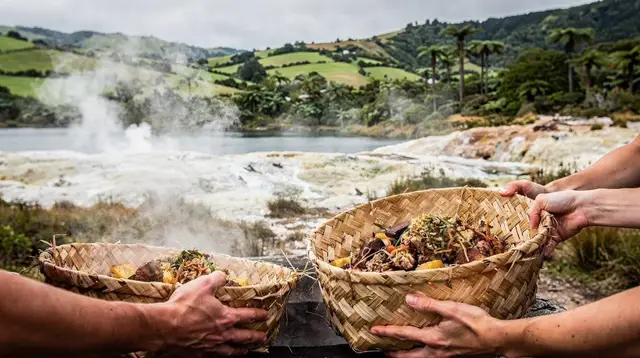
The food itself is straightforward. Meat — commonly chicken, pork or lamb — sits alongside root vegetables: potato, kumara (sweet potato), pumpkin, and often cabbage or squash. Each type of food is usually wrapped separately, traditionally in leaves and now more often in wire baskets lined with foil or cloth, so everything cooks together without the flavours turning to mush. The baskets are lowered in a particular order, meat first since it needs the longest cooking time and sits closest to the heat, vegetables layered above.
What makes the result distinctive is not the ingredients but the process: no direct flame touches the food, no water is added, and nothing is stirred or checked along the way. The food effectively steams in its own moisture and the moisture given off by everything packed around it, sealed under earth or a lid for three to four hours. The texture that comes out is closer to slow steaming than roasting — moist, smoky at the edges, and noticeably different from the same ingredients cooked in an oven.
Two ways to cook it: stones or steam
The traditional hāngī, used across the North Island for generations, relies on heated stones. Volcanic rock is chosen because it holds heat well and does not shatter under sudden temperature change, which matters because it is heated in a wood fire for an hour or more before the food ever goes near it. Once the stones are glowing, the fire is raked away, the wrapped food baskets go on top, and the whole pit is covered — earth, then often a wet cloth or mat to trap steam and keep dirt out of the food, then a final layer of soil.
Rotorua’s version of this can look almost the same from the outside, but the heat source underneath is different. Because the ground here sits directly over an active geothermal field, steam vents naturally in places — sometimes strongly enough to cook with directly. A steam box built over one of these vents needs no fire, no stones, and no hours of preheating. The food goes in, the box is sealed, and the earth itself supplies a steady, moist heat for as long as it takes. It is the same underlying idea — slow, sealed, steam cooking — arrived at by a completely different route, using a heat source that exists nowhere else in the country in quite this form.
Traditional stones vs Rotorua’s geothermal steam
| Traditional hāngī (stones) | Rotorua geothermal steam | |
|---|---|---|
| Heat source | Wood fire heating volcanic stones | Natural steam venting from the ground |
| Preparation | Fire lit and stones heated for an hour or more beforehand | Steam is already there; no preheating needed |
| Where it’s used | Anywhere in New Zealand | Specific to geothermally active ground like Rotorua |
| What’s underneath | Glowing stones, raked fire embers | A vent or box channelling natural steam |
| Everyday use today | Mostly reserved for special occasions and marae gatherings | Still used for ordinary household cooking in parts of Whakarewarewa Village |
Both methods are genuinely Māori and both are still practised. Neither is more “authentic” than the other — the stone method is the older and more widespread technique, while the steam version is a local adaptation that makes sense only where the ground itself is hot. If you want to understand why the ground behaves this way at all, it connects to the same geothermal system explained in why Rotorua smells of sulphur.
Community steam cooking at Ōhinemutu and Whakarewarewa
This is not only a demonstration laid on for visitors. In parts of Whakarewarewa Village and around Ōhinemutu, residents still cook everyday meals in steam boxes built over natural vents in their own gardens — the geothermal ground is treated as infrastructure, not spectacle. Walking through either village, it is common to see small covered boxes sitting over patches of steaming ground, doing exactly this job at that moment for someone’s dinner rather than for a tour group.
That distinction matters for how you read a cultural visit. A guided walk through Whakarewarewa Village that points out a working steam box is showing you something that functions the same way whether or not visitors are there. A hāngī laid on specifically for an evening cultural performance is a different, more formal version of the same idea — still genuine, but staged for an audience rather than happening incidentally. Both are worth experiencing; it just helps to know which one you are booking.
Where to eat a real hāngī in Rotorua
The most reliable way to eat a properly cooked hāngī as a visitor is through a guided cultural experience rather than a standalone restaurant meal — no restaurant in the region serves hāngī as an everyday menu item, since the cooking time and method don’t suit a normal kitchen service. Instead, hāngī is built into longer cultural visits and evening performances, timed so the meal is ready to open and serve as part of the programme.
a shared afternoon and evening experience around Te Puia that includes a hāngī-style meal is one way to combine the geothermal valley and the food in a single visit. For something built specifically around performance and food together, an evening of Māori cultural performance paired with a hāngī dinner gives you the kapa haka and the meal side by side, which is a useful pairing if you also want context on what the haka means before you see one performed.
If your priority is the village and its living, working geothermal ground rather than a formal evening programme, a guided walk through Whakarewarewa Village is where you’re most likely to see steam-box cooking as an ordinary part of daily life, with a local guide explaining what’s being cooked and why the ground is used this way. Those wanting the fuller package — geothermal valley, cultural context and a spa afterwards — can look at a combined Māori world tour with a luxury spa package, though the hāngī meal itself is the same underground or steam-cooked food regardless of which tier you book.
For a shorter, values-focused version, a 3.5-hour shared cultural experience built around the Tiaki Promise covers the visitor-behaviour commitment alongside the cultural content, which is a useful primer if you haven’t yet read up on what that commitment actually asks of you — see the Tiaki Promise explained for the background.
What a hāngī evening usually looks like
Most cultural evenings that include a hāngī follow a similar shape, though details vary by operator. Guests typically arrive before the meal is served, often in time to see the food lowered into the pit or steam box, or — more commonly, since cooking takes hours — to see it lifted out and unwrapped near the end of the visit. A pōwhiri or welcome usually opens the evening, followed by cultural performance, with the meal served either during or after. The food itself is generally served buffet-style once it comes out of the ground, since a whole hāngī is cooked in one batch for everyone rather than plated individually.
Because the whole process runs on a fixed cooking time of several hours, evening programmes tend to be scheduled tightly and don’t flex much for latecomers. If seeing the pit or steam box opened matters to you specifically, it’s worth asking when booking whether that moment falls early or late in the evening, since some operators time it as an opening ritual and others save it for right before the meal is served.
Etiquette worth knowing before you go
A hāngī served as part of a cultural evening is still a shared meal in a Māori context, and a few small habits go a long way. Wait to be invited to eat rather than starting the moment food appears — a karakia (blessing) is often said first. If you’re offered food by someone hosting the evening, it’s polite to accept even a small amount rather than declining outright. Basic courtesies around photography also apply: ask before photographing the pit being opened up close, since for some hosts this is a significant moment rather than a photo opportunity. A fuller rundown of these habits, useful well beyond just the meal, is in Māori cultural etiquette in Rotorua.
None of this is complicated, and hosts generally guide guests through it as the evening unfolds. It helps, though, to arrive already understanding that a hāngī sits inside a broader set of customs — welcome, blessing, performance, food — rather than being a meal that happens to be served at a cultural show.
What it costs
Hāngī is almost never sold as a standalone meal — it’s bundled into a longer cultural experience, evening performance, or day tour, so the price reflects the whole programme rather than the food alone. As a rough guide, an evening cultural experience with a hāngī-style meal tends to sit comfortably within a typical mid-range daily travel budget for Rotorua, with shorter shared experiences at the lower end and combined packages that add a spa or luxury tier costing more. There’s no meaningful way to buy “just the hāngī” separately from the cultural programme it’s part of.
Hāngī beyond Rotorua
Because the stone-cooking method doesn’t depend on geothermal ground, hāngī is cooked and eaten across the North Island — at marae gatherings, family occasions, and some cultural tourism experiences elsewhere. What’s specific to Rotorua is the steam-box variant and the fact that, in villages like Whakarewarewa, geothermal cooking is a visible, working part of daily life rather than something reserved for special occasions. If you’re building a wider itinerary and want to understand how this fits with the rest of Te Arawa history and culture, Te Arawa history in Rotorua covers the background, and comparing Rotorua’s Māori cultural experiences lays out how the various evening and daytime options differ beyond just the food.
Hāngī, hot pools and the same hot ground
It’s worth connecting the dots between what’s on your plate and what’s under your feet. The same geothermal system that lets some Rotorua cooks skip the fire and stones entirely is the one responsible for the steam drifting off footpaths, the hot pools scattered around the district, and the smell that greets most first-time visitors — explained in full in why Rotorua smells of sulphur. A hāngī cooked with steam rather than stones is a genuinely practical use of that same ground, not a novelty invented for tourism. For a sense of how this history took shape over more than a century of visitors, Rotorua’s history of spa tourism traces how the town’s geothermal ground turned into its main drawcard long before hāngī dinners were part of any organised itinerary.
If you’re planning where a cultural evening with a hāngī fits into a broader trip, it slots naturally alongside a geothermal park visit earlier in the day — see Rotorua’s geothermal parks: which one to choose — or as the centrepiece of a short, culture-focused stay outlined in a two-day Māori culture itinerary. Either way, the meal itself is worth treating as more than dinner: it’s one of the more concrete demonstrations, on a plate, of what it means for a town to be built on genuinely active ground.
Hāngī: what it is and where to eat one — the essentials
For a quick recap: a hāngī is food cooked slowly underground or in a sealed steam box, wrapped and layered rather than grilled or boiled, traditionally heated by stones and, uniquely in Rotorua, sometimes heated by the earth’s own geothermal steam instead. You’ll eat the most genuine version as part of a guided cultural experience or evening performance built around Te Puia or Whakarewarewa Village, not at a standalone restaurant. The questions below cover the details most visitors ask before booking.
What is a hāngī, exactly?
A hāngī is a traditional Māori method of cooking food in a pit dug in the ground. Meat and vegetables are wrapped, usually in baskets or foil, then lowered onto heated stones or a steam source and covered with earth or cloth so the food steams slowly for several hours.
Is hāngī cooked differently in Rotorua than elsewhere in New Zealand?
The wrapping and the slow underground cooking are the same everywhere. What differs in Rotorua is the heat source: because the area sits on active geothermal ground, some cooks use natural steam venting from the earth instead of stones heated over a wood fire.
What food is usually in a hāngī?
Typically meat such as chicken, pork or lamb, alongside root vegetables like potato, kumara (sweet potato), pumpkin and cabbage. The steam cooking gives everything a smoky, moist texture that is different from oven roasting or boiling.
Where can I eat a real hāngī in Rotorua?
Cultural experiences built around Te Puia and Whakarewarewa Village regularly include a hāngī-style meal as part of a guided visit or evening performance. These are the most reliable places to eat one cooked and served in a genuinely Māori context rather than as a generic buffet.
Can I see a hāngī pit being opened?
Many cultural evenings time the visit so guests see the earth or steam box opened and the food lifted out, which is part of the experience rather than an extra. Ask when booking if watching the opening matters to you, since timings vary by operator.
Do people in Rotorua still cook with geothermal steam at home?
Yes. In parts of Whakarewarewa Village and around Ōhinemutu, some residents use steam boxes built over natural vents to cook everyday meals, not just for visitors. It is a working method, not a demonstration.
Is hāngī the same as a barbecue or hot pot?
No. A hāngī is cooked entirely underground or in an enclosed steam box, with no open flame touching the food and no liquid added. The result is closer to slow steaming than grilling, which is why the texture and smell are distinctive.
How much does a hāngī dinner in Rotorua typically cost?
It is usually bundled into a cultural evening or guided experience rather than sold as a standalone meal, so the price reflects the whole package. As a rough guide, a mid-range evening cultural experience with a meal sits within a typical mid-range daily travel budget for Rotorua.
Māori culture & heritage tours on GetYourGuide
Verified deep-linked GetYourGuide tours. Book through these links and we earn a small commission at no cost to you.
Photos show the destination, not the operator's own images.