The Haka: What It Really Means
What does the haka actually mean?
The haka is a form of te reo Māori expression performed with chant, posture, and facial expression, and it takes many forms beyond war — welcome, celebration, mourning, and challenge among them. In a pōwhiri, a wero may be laid down before visitors are accepted onto the marae, and the correct response is to stay still, follow the appointed leader of your group, and never touch the item placed at your feet until you are told to.
Most visitors arrive in Rotorua having seen exactly one version of the haka: the All Blacks performing Ka Mate before a rugby test, filmed close-up and often slowed down for television. That single clip has done more than anything else to shape how the world reads this practice — as a pre-match war cry, all aggression and no context. It is not wrong, exactly. It is just a fragment of something much larger, and arriving in Rotorua with only that fragment can make an actual pōwhiri confusing, or worse, make a visitor react in a way that reads as disrespectful without meaning to be.
Rotorua sits at the centre of Te Arawa country, and here the haka is not a tourist spectacle staged for cameras — it is a living form of communication still used for welcome, grief, celebration, and challenge, the same way it has been for generations. This guide covers what a haka is actually saying, why it is not only about war, and specifically what to do with your body and your attention if one is performed in front of you during a pōwhiri.
More Than a War Dance
Haka is a general term for a type of Māori performance that combines chant, coordinated movement, facial expression, and often stamping or slapping of the body, all working together to project a message. The word covers a whole family of forms, not one fixed routine. A haka taparahi is a posture dance performed without weapons — this is the category Ka Mate belongs to, and it is the most common form seen today. A peruperu, historically performed with weapons before combat, is closer to what people picture when they hear “war dance,” but it is a specific and now rare subtype, not the whole category.
Haka also exist for occasions that have nothing to do with conflict. There are haka of welcome, extended to honoured guests as a mark of respect. There are haka of celebration, performed at graduations and weddings. There are haka of mourning, performed at tangihanga to express grief that words alone cannot carry. What ties all of these together is not aggression but intensity — a haka is a full-body, full-voice act of communication, and the emotion it carries depends entirely on the occasion and the words of the chant, which are frequently missed by an audience that does not speak te reo Māori.
Facial expression is part of the message, not decoration. The exaggerated eye-widening, known as pūkana, and the extended tongue, known as whetero, are deliberate techniques used to project intensity and to punctuate the rhythm of the chant — they are performance craft, not random provocation. Understanding that the vocabulary of the face is doing real work changes how the whole performance reads.
Where Haka Comes From
Haka predates written Māori history and was passed down orally, tied closely to whakapapa — genealogy — and to specific iwi and hapū rather than existing as one generic national dance. Different regions and different groups have their own haka, composed for particular ancestors, particular events, or particular challenges, and a haka performed by Te Arawa carries different words and different history than one composed elsewhere in the country. Learning even a little of that context before a performance in Rotorua — through Te Arawa’s history in this region — makes what you are watching mean something more specific than “traditional dance.”
The Ka Mate haka that most visitors already know by name was composed by the Ngāti Toa chief Te Rauparaha in the early nineteenth century, reportedly after escaping death by hiding, and its words describe that survival — “ka mate, ka mate, ka ora, ka ora” translates roughly as “I die, I die, I live, I live.” It became internationally famous through rugby, first performed by a New Zealand team in the early twentieth century, and it is now the form most non-New Zealanders can picture. It is one composition among hundreds, not a generic template for the art form.
The Pōwhiri: Where Visitors Meet the Haka
For most people in Rotorua, the setting where a haka is encountered is a pōwhiri — the formal Māori process of welcoming visitors onto a marae or into a cultural space. A pōwhiri has a defined sequence: a call from the women of the host group, speeches from both sides, waiata following each speech, and a hongi — the pressing of noses and foreheads — that closes the physical distance between hosts and guests. Haka can appear at more than one point in this sequence, either as part of the welcome itself or, before it even begins, as a wero laid down at the gate.
Cultural experiences built around Rotorua’s geothermal valleys generally include some version of this structure, adapted for a shorter visit but keeping its shape. Both Whakarewarewa Living Village and Te Puia run guided experiences that open with a pōwhiri element, and it is worth reading our comparison of Te Puia and Whakarewarewa Village beforehand if you are choosing between the two, since the two experiences differ in pace and setting even though both are run within the Te Arawa community rather than staged separately from it.
a guided walk through Whakarewarewa’s living thermal village generally includes a cultural welcome as part of the tour, led by residents of Tūhourangi Ngāti Wāhiao who still live in the valley.
The Wero: Being Challenged
The most formal and most misunderstood moment is the wero — a ceremonial challenge issued by a warrior of the host group before visitors are accepted. Historically, the wero tested whether an approaching group came in peace or in hostility. A challenger advances toward the visitors performing a haka, and at the end lays down an object, traditionally a small carved dart or a fern frond, on the ground in front of the group’s designated leader.
What that leader does next matters. Picking up the item, without flinching or turning away, signals that the visitors come in peace and are accepted for the welcome to proceed. This is the piece of the ceremony most likely to be adapted for tourism, since a group of unrelated travellers rarely has an obvious leader — at most commercial cultural experiences, a guide will identify or appoint someone from the group in advance, brief them on exactly what to do, and stand nearby to help. You are not expected to know this instinctively. You are expected to listen to your guide’s briefing and follow it.
For everyone else in the group who is not the designated leader, the expected behaviour during a wero is simple: stand still, stay quiet, and watch. Do not laugh, do not clap, do not step forward, and do not reach for your phone unless you have already been told filming is permitted at that moment — some wero, particularly ones directed at a specific individual, are treated as too significant to record. Our guide to Māori cultural etiquette in Rotorua covers this and the wider set of behavioural expectations — including how to conduct yourself during a hongi and inside a wharenui — in more detail than a single section here can.
How to Stand, Watch, and Respond
Outside the specific structure of a wero, the general etiquette for watching any haka performed for you follows the same logic. Face the performers directly rather than sideways or with your back partially turned. Keep your body still and your hands down at your sides rather than fidgeting or clapping midway through — applause, when appropriate, comes at the end, once the performance has clearly finished, not during it. Silence during the performance is not coldness; it is closer to how a performer would want to be heard.
If you are invited to respond — with a waiata, a word of thanks, or simply applause — that invitation will usually be clear, often signalled directly by whoever is leading the ceremony on the host side. Until that invitation comes, the correct role of a visitor is attentive stillness, not participation. This applies whether you encounter the haka inside a formal pōwhiri at Ohinemutu, a functioning village where Ngāti Whakaue still live around St Faith’s church, or inside a scheduled show at a commercial venue — the performance deserves the same attention either way, because for the performers it is not a costume change between acts.
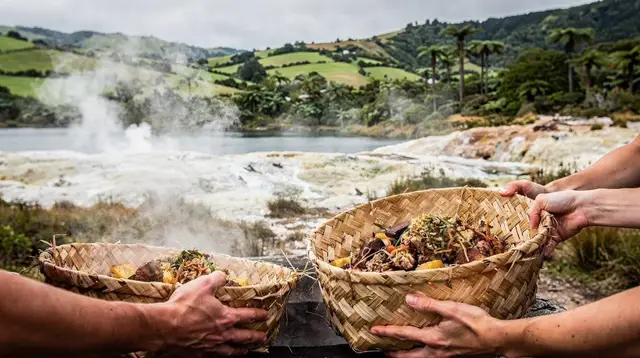
A hāngī dinner often follows or precedes a cultural performance in Rotorua, cooked in an earth oven and, at several venues here, steamed using geothermal heat rather than buried coals — our guide to hāngī and where to eat one explains how that works and where it is served alongside an evening of performance.
Where You Can See Haka Around Rotorua
Rotorua has more places to see a genuine, community-run haka performance than almost anywhere else in the country, because Te Arawa’s cultural institutions built their visitor experiences around hosting rather than performing for an empty room. Te Puia runs two distinct formats: Te Pō, an evening experience built around a hāngī dinner followed by an indoor performance, and Te Rā, a daytime version paired with a guided walk through the geothermal valley and the national carving school.
Te Puia’s evening programme, which pairs a hāngī dinner with a haka and waiata performance runs after dark, when the geothermal valley outside is lit rather than daylit, and the performance takes place indoors.
For a shorter, standalone option without a full dinner attached, a dedicated cultural performance featuring haka and traditional dance is a way to see the art form without committing to a full evening itinerary.
Nearby, the village at /destinations/whakarewarewa-village/ integrates its cultural welcome into daily guided tours rather than a separate evening show, since it is a place people live in rather than a venue built solely for performance. If your itinerary includes only one Māori cultural stop, comparing the options laid out in our comparison of Rotorua’s Māori cultural experiences will help you pick between an evening dinner-and-performance format and a daytime walking one.
History matters here too. The village of Te Wairoa, the Buried Village, destroyed in the 1886 eruption of Mount Tarawera, is a reminder that these are living communities with a documented, and at times devastating, history rather than a fixed backdrop for photographs. Treating a haka performance as a snapshot of unchanging tradition misses that it belongs to communities that have kept adapting it through massive disruption, including that eruption, without losing what it means.
Watching Respectfully: A Quick Reference
| Moment | What is happening | What to do |
|---|---|---|
| Wero at the gate | A challenger tests whether visitors come in peace | Stay still and silent; only the designated leader picks up the item placed on the ground |
| Haka during a pōwhiri | Welcome, challenge, or acknowledgement addressed to the group | Face the performers, stay quiet, do not clap until it clearly ends |
| Haka at an evening cultural show | Scheduled performance, usually after a hāngī dinner | Photography is often allowed — check with your guide first, since some moments may not be |
| Invitation to respond | Hosts invite guests to sing, speak, or try an action song | This is the moment to participate, not before it |
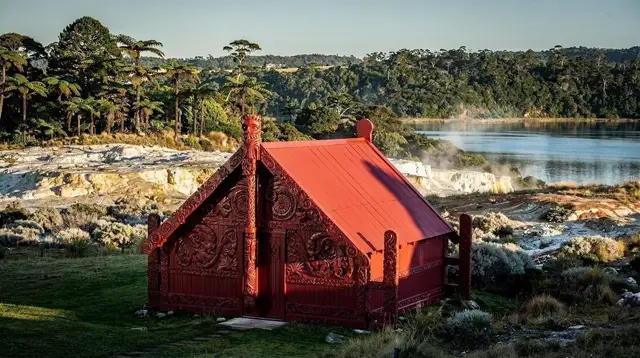
Before any of this, it is worth reading /guides/te-arawa-history-rotorua/ for the wider context of who is hosting you, and our guide to Māori arts and crafts in Rotorua if you want to understand the carving and weaving traditions that often surround these performances, since the meeting house a haka is performed in front of is itself carrying its own layered history in wood. None of this requires expertise — it requires paying attention, following your guide, and treating the moment as what it is for the people performing it, not what it looked like the one time you saw it on television.
A two-day itinerary built around our two-day Rotorua Māori culture itinerary pairs a cultural evening like Te Pō with a daytime visit to a living village, giving enough time to see both the formal welcome structure and the everyday life around it, rather than a single performance taken in isolation. And broader visitor conduct in Māori spaces, beyond haka specifically, is covered under the country’s Tiaki Promise, explained at our explainer on the Tiaki Promise, alongside a short primer on pronunciation at how to pronounce New Zealand place names and everyday te reo Māori vocabulary useful for travellers at everyday te reo Māori words for travellers.
Haka Questions Visitors Ask in Rotorua
Is the haka always a war dance?
No. The best-known form performed before rugby matches is a haka taparahi, a posture dance without weapons, but haka exist for welcome, for farewell, for grief, and for celebration. Only some historical forms, like the peruperu performed with weapons, were specifically for war.
What is a wero and will I be challenged during my visit?
A wero is a ceremonial challenge laid down by a warrior at the start of a formal pōwhiri, testing whether visitors come in peace. It is common at cultural experiences around Rotorua, including at Te Puia and Whakarewarewa Village, and a guide will brief your group on what to do before it happens.
How should I react if a haka is performed for my group?
Stay quiet and still, keep your hands by your sides rather than clapping partway through, and follow the lead of whoever in your group has been designated to respond. Watching attentively is the expected response — a haka is not a cue to join in unless you are explicitly invited to.
Is it okay to record or photograph a haka?
At most commercial cultural performances around Rotorua, photography and video are permitted and often encouraged, but always check with your guide first, since a small number of ceremonial moments — particularly a wero directed at a specific person — are not meant to be filmed.
Do women perform haka too?
Yes. Haka is not exclusively male, though the wero and some of the more forceful postures are traditionally performed by men, while women often lead waiata and poi alongside mixed-gender group performances at cultural venues.
What is the difference between Te Pō and Te Rā at Te Puia?
Te Pō is Te Puia’s evening cultural experience, built around a hāngī dinner and an indoor performance that includes haka and waiata. Te Rā is the daytime version, a guided walk through the geothermal valley and carving school paired with a shorter cultural performance.
Can I join in or is that disrespectful?
Joining in uninvited is not appropriate — a haka is a performance with structure and meaning, not audience participation. Some cultural evenings do invite guests to learn a simple action song or try the poi afterwards, and that is the moment to take part, not during the haka itself.
Māori culture & heritage tours on GetYourGuide
Verified deep-linked GetYourGuide tours. Book through these links and we earn a small commission at no cost to you.
Photos show the destination, not the operator's own images.