Māori Arts and Crafts in Rotorua: Carving, Weaving and Pounamu
Where can I see Māori wood carving, weaving and pounamu carving in Rotorua?
Te Puia and Whakarewarewa Village both have working carving and weaving spaces open to visitors, and several Rotorua galleries sell pounamu, carved wood and woven harakeke made by named artists. An authentic piece is hand-worked from real stone or fibre and sold with the maker identified, not imported and mass-produced.
Three crafts that are still practised daily, not preserved behind glass
Rotorua is the easiest place in New Zealand to see three Māori art forms made in front of you rather than only displayed in a case: whakairo (wood carving), raranga (weaving, mostly with the native flax harakeke), and the carving of pounamu, a form of jade. All three have a working home in Whakarewarewa Village and at Te Puia, the national institute for Māori arts and crafts that shares the same thermal valley. This guide covers where each craft is made and taught, and how to tell a genuinely hand-made piece from an imported copy before you buy one.
None of this is staged for tourists in the sense of being invented for them. Carving and weaving are skills that were at risk of dying out within a generation or two in the twentieth century, which is a large part of why formal schools were set up specifically to keep them alive and pass them to the next carvers and weavers. Watching someone work at a chisel or split harakeke leaves by hand in Rotorua is watching that transmission happen, not a re-enactment.
Whakairo: wood carving in Rotorua
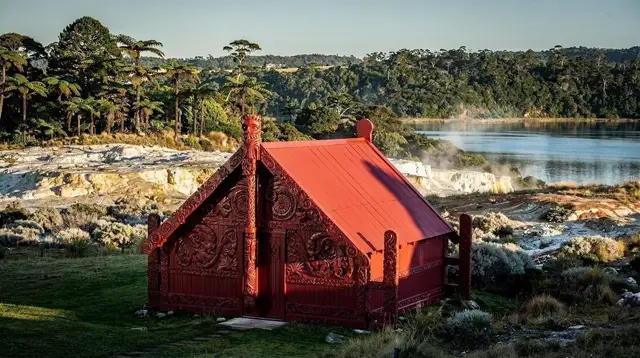
Whakairo is carving worked into meeting houses (wharenui), gateways, canoes (waka), storage structures, and smaller pieces such as walking sticks, boxes and pendants. Traditional carving uses native timbers, most commonly totara, valued for being straight-grained and relatively easy to work while still durable. Patterns are not random decoration: spirals, human figures and surface textures each belong to a vocabulary that can record ancestry, tribal identity or a specific story, which is one reason a carved meeting house is read almost like a text by people who know how.
At Te Puia, the carving school is one of the two formal schools that make up the institute (the other is weaving), and visitors can walk past students and qualified carvers working on pieces destined for meeting houses around the country. It is a working school, not a museum diorama, so what you see on any given day depends on what the current students are working on. The comparison of Te Puia and Whakarewarewa Village is worth reading before you choose between them, since they overlap but are not identical experiences.
At Whakarewarewa Village, carving happens as part of a residential community’s daily life rather than inside a school building. Tūhourangi Ngāti Wāhiao families live in the village, and carvers there work commissions the same way any craftsperson does, fitting the work around a normal day. This is a different texture of visit to Te Puia’s more institutional setting, and it connects directly to the wider history of Te Arawa in Rotorua, the collective of tribes the village belongs to.
If you continue north to the Bay of Plenty coast, carved and sculptural work also appears outside the two main sites. A visit that pairs a garden or sculpture setting with the coast can work well as a change of pace from thermal valleys: a half-day tour through Te Puna’s sculpture park and a historic village near Tauranga shows a different, less formal side of New Zealand craft and outdoor art, worth knowing about if you are basing part of a trip around Tauranga.
Raranga: weaving with harakeke
Raranga is weaving, and its main material around Rotorua is harakeke, a native flax plant with long, strap-like leaves that grows in wet ground across much of the North Island. Harakeke is not a byproduct of another activity; specific plants and even specific leaves are chosen and cut with the finished piece in mind, and preparing the fibre — stripping, softening and sometimes dyeing it — is as skilled and time-consuming as the weaving itself. Everyday items made this way include kete, woven baskets used for carrying and storing, and mats; more elaborate cloaks (kākahu) that incorporate feathers are a slower, more specialised undertaking.
Te Puia’s weaving school, Te Rito, sits alongside its carving school as the second half of the same national institute, and weavers can often be seen working there during a visit. At Whakarewarewa Village, weaving is also part of daily life rather than a scheduled performance, in the same way carving is: harakeke grows locally, and older residents pass the skill on within families, which is a large part of why the village describes itself as lived-in rather than reconstructed.
Both crafts sit inside a broader set of cultural practices you will encounter around Rotorua, from the haka performed at cultural evenings to the hāngī cooked in an earth oven. If you are choosing between the several cultural experiences on offer in and around town, the comparison of Rotorua’s Māori cultural experiences lays out which ones include a genuine look at carving or weaving versus which focus on performance and food.
Pounamu: jade that travels from the South Island
Pounamu is often called greenstone or New Zealand jade. It is not native to the Rotorua area or to the volcanic zone at all: workable pounamu is found in a small number of rivers on the South Island, several hundred kilometres away, and has been carried and traded across the country for generations, long before any road or vehicle existed to move it. That long-distance trade is exactly why pounamu carving happens in Rotorua today despite the raw stone coming from somewhere else entirely — the finished stone travels, and skilled carvers work it wherever they are based.
A carved pounamu pendant or tool is valued for more than its material. Traditional forms include the hei-tiki (a stylised human figure worn as a pendant), the hei matau (a fish hook shape, associated with safe travel over water), and the toki (an adze shape, associated with strength and purpose). Some visitors follow a customary preference of not buying a pounamu piece for themselves and instead receiving one as a gift, on the idea that a gifted piece carries more meaning over time — this is a personal or family custom rather than a rule imposed on tourists, and buying one for yourself from a genuine maker is common and accepted.
You will find pounamu carving and sales connected to several cultural sites and galleries around Rotorua, often alongside wood carving in the same building. A shore excursion or half-day tour that includes Te Puia typically passes both the carving school and a gallery space where finished work, including pounamu, is on sale — useful if your time in Rotorua is limited to a single stop, such as a half-day excursion from Tauranga that takes in Te Puia’s geothermal valley and carving school, a common option for cruise passengers docking at Tauranga for the day.
Where to watch the crafts being made
| Location | What you see | Formality |
|---|---|---|
| Te Puia | Working carving school and weaving school (Te Rito), plus a retail gallery | Institutional, structured visit |
| Whakarewarewa Village | Carving and weaving as part of daily community life | Lived-in, informal |
| Ōhinemutu | Carved meeting house and church detail in a working lakeside village | Informal, self-guided |
| Rotorua galleries and craft shops | Finished carved wood, pounamu and woven pieces for sale | Retail |
| Mount Tarawera guided visits | Cultural and historical context for carving motifs tied to the mountain and the 1886 eruption | Guided only, iwi-led |
Ōhinemutu, the Ngāti Whakaue village within Rotorua itself, is worth a stop for its carved meeting house and for St Faith’s church, where a Christ figure is etched into a window pane so it appears to stand over the lake. It is a working village, so visit with the same care you would show any residential street, not as a photo backdrop.
For carving with a historical rather than a shopping angle, Te Wairoa, the buried village, preserves what was left after the 1886 Tarawera eruption, including surviving structural and carved elements from a settlement that existed before the disaster. Guided access to Mount Tarawera itself, which belongs to the iwi and cannot be visited independently, often includes context on how the mountain and the eruption feature in local carving and oral tradition.
If you want a broader sense of Rotorua’s cultural sites beyond crafts specifically, the Rotorua museum and Government Gardens guide and the things to do in Māori culture category page both work as starting points for building a wider cultural day.
Where to learn a craft yourself
Full training as a carver or weaver takes years and is not something a short visit can substitute for. What is realistic on a trip is an introductory taste: some cultural sites and independent tutors around Rotorua run short sessions that let visitors try basic weaving with harakeke or simple carving techniques under supervision. These change with the season and with who is available to teach, so the reliable approach is to ask directly at Te Puia or Whakarewarewa Village, or check current listings when you are in town rather than assuming a fixed weekly schedule.
If a hands-on craft session doesn’t work out, a hāngī and cultural evening booked through one of the operators compared in the Māori cultural experiences guide often still includes some explanation of carving and weaving alongside the performance and food, even where there is no separate workshop.
For visitors who want a broader New Zealand craft experience beyond Rotorua’s Māori arts specifically, a change of material and setting is available further afield: a wheel-throwing pottery class over on the Coromandel Peninsula is unrelated to Māori carving traditions but is a genuine, hands-on craft option if your itinerary extends that far north and you want to try working with your hands again in a different medium.
How to recognise an authentic piece
A few checks help separate a genuinely hand-made carving, woven piece or pounamu carving from a mass-produced import sold as a souvenir:
- Material. Real pounamu is cool to the touch, dense, and shows slight translucency at thin edges when held to light; dyed glass or resin tends to look uniformly flat and feels lighter. Carved wood should show tool marks and grain consistent with hand work rather than a perfectly smooth, machine-uniform finish.
- Provenance. A shop or gallery that names the artist, or is directly attached to a cultural institution such as Te Puia, is a stronger signal than a generic souvenir stand with no attribution. Ask who made a piece; a seller who can answer is usually selling the real thing.
- Price relative to material. Genuine pounamu carving takes real time and skill to cut and polish; a piece priced far below what that labour would justify is worth questioning, even allowing for a wide range between a small pendant and a large, elaborate work.
- Pattern consistency. Traditional whakairo and raranga patterns follow recognisable conventions; pieces that mix unrelated motifs in a way that looks purely decorative, with no coherent meaning, are more likely aimed at a fast tourist sale than made within the tradition.
- Where it’s made, not just where it’s sold. A tag reading “New Zealand” is not the same as being made in New Zealand by a Māori artist; some souvenir carving and jewellery sold nationally is imported. Buying at or near Te Puia or Whakarewarewa Village reduces this risk considerably.
None of this requires expertise before you arrive. Asking a direct question — who made this, and where — is normal in these settings and is usually answered readily by staff and artists alike.
Buying respectfully: what to ask
Beyond authenticity, a little context helps a purchase feel appropriate rather than transactional. It is reasonable to ask what a particular carved motif or pattern represents, since many carvers are glad to explain meaning to an interested visitor — this is closer to how the craft has always been shared than a barrier to keep outsiders out. For pounamu specifically, if you are drawn to a piece as a gift rather than for yourself, saying so to the seller is common and can shape which piece or size they suggest.
General cultural etiquette in Rotorua also applies inside galleries and workshops: ask before photographing an artist at work, and treat a carving school or weaving room the way you would any workplace where people are concentrating on skilled, often slow, manual work.
Building crafts into a wider Rotorua visit
Arts and crafts pair naturally with the rest of Rotorua’s cultural offering rather than needing a separate trip. A two-day Māori culture itinerary typically has room for both Te Puia and Whakarewarewa Village, plus a hāngī and cultural evening, which covers carving, weaving, food and performance without feeling rushed. If your schedule is tighter, deciding how many days to spend in Rotorua first will make it easier to see how much of this fits alongside the geothermal parks and outdoor activities most visitors also want to see.
Combining a Te Puia visit with the wider haka and geothermal circuit is also a common single-day option, particularly for visitors travelling in from further afield: a day trip from Hamilton that combines Wai-O-Tapu’s geothermal features with Te Puia and a haka performance is one way to see carving and weaving alongside the landscape in a single outing if you are not based in Rotorua itself.
Whichever combination you choose, the throughline is the same: whakairo, raranga and pounamu carving in Rotorua are living skills being actively passed on, not a fixed historical display, and the best way to appreciate them is to watch someone actually doing the work.
Māori arts and crafts in Rotorua: frequently asked questions
What is whakairo?
Whakairo is Māori wood carving. It is used on meeting houses, gateways, canoes and smaller objects, and each carved figure and pattern can carry a specific ancestral or tribal meaning rather than being purely decorative.
What is raranga and what is harakeke?
Raranga is Māori weaving, and harakeke is the native flax plant whose long leaves are the main raw material. Weavers use it to make kete (baskets), mats, and finer garments, stripping and preparing the fibre by hand before weaving.
Where does pounamu (greenstone) come from?
Pounamu is a form of jade found in a small number of rivers on New Zealand’s South Island, not around Rotorua. It has been traded and carried across the country for generations, which is why it is worked and sold in Rotorua despite not being sourced locally.
Can I watch Māori carvers and weavers at work in Rotorua?
Yes. Te Puia runs a working carving school and weaving school that visitors can walk through, and Whakarewarewa Village, a lived-in community, also has artists carving and weaving on site as part of daily life rather than a staged display.
Can I take a carving or weaving class in Rotorua?
Short introductory sessions in carving or weaving are offered at some cultural sites and by independent tutors around Rotorua, aimed at visitors rather than training full practitioners. Ask at Te Puia or Whakarewarewa Village directly about current sessions, since availability changes.
How do I know if a pounamu or carved piece is authentic?
Check the material first: real pounamu is cool, dense and slightly translucent at thin edges, unlike dyed glass or resin. Buy from a named artist, a gallery attached to a cultural centre such as Te Puia, or a shop that states where and by whom a piece was made, and be wary of unusually low prices on “greenstone” souvenirs.
Is it disrespectful to buy or wear pounamu as a visitor?
Buying pounamu made and sold by Māori artists is common and welcomed. Some visitors choose not to buy a pounamu pendant for themselves and instead receive one as a gift, following a customary preference, though this is a personal choice rather than a strict rule for tourists.
What is the difference between Te Puia and Whakarewarewa Village for seeing arts and crafts?
Te Puia is a national institute built around formal carving and weaving schools alongside its geothermal features, while Whakarewarewa Village is a residential community where carving and weaving happen as part of everyday life. Both sit in the same valley and are often combined in a single visit.
Māori culture & heritage tours on GetYourGuide
Verified deep-linked GetYourGuide tours. Book through these links and we earn a small commission at no cost to you.
Photos show the destination, not the operator's own images.