Rotorua Māori Cultural Evenings Compared
Which Rotorua Māori cultural evening should I choose?
There is no single best answer. Whakarewarewa is the only one where people actually live, which changes the register from performance to daily life. Te Pā Tū and Tamaki are the most theatrical and immersive, built around a bus journey and a staged welcome. Mitai sets its welcome on a stream by torchlight and pairs it with a glowworm walk. Te Puia's evening, Te Pō, is the only one built around a working geothermal valley and Pōhutu geyser. Group size, price tier and how much staging you want are what actually separate them.
Rotorua sits at the heart of Te Arawa country, and it is also the one place in New Zealand where a visitor can book an evening built around a hāngī, a haka and a formal welcome almost every night of the year. That density is useful and also confusing: five or six operators run broadly similar-sounding evenings, priced differently, staged differently, and pitched at different kinds of travellers. This guide compares the main ones on the things that actually matter when you are choosing — price tier, length, group size, and how staged the evening feels — rather than on marketing language. For a broader honest take on the destination beyond these evenings, see our honest verdict on Rotorua.
What “cultural evening” actually means in Rotorua
Almost every one of these programmes follows the same rough shape: arrival and a pōwhiri-style welcome, a seated or standing cultural performance including haka and waiata, a hāngī meal cooked in an earth oven (at some venues cooked with geothermal steam rather than buried coals), and transport back to central Rotorua where relevant. What differs between operators is the setting, how much theatre is built around the arrival, how large the groups run, and whether the venue is a constructed experience built for visitors or a place where people also live and work by day. If some of the Māori terms above are unfamiliar, our guide to Māori words worth knowing before you travel and our explainer on how to pronounce New Zealand place names cover both.
None of this is a ranking of which culture is more “real” — Te Arawa people work at all of these venues, and the performers, guides and kitchen staff are drawing on the same living traditions wherever you go. The difference is in format, not in legitimacy.
The five experiences, venue by venue
Te Pā Tū
Te Pā Tū is one of the more theatrical formats: visitors are collected by bus from central Rotorua and driven into native forest to a recreated pre-European village, with the journey itself used to set up a haka challenge at the gate before guests are welcomed in. The evening moves guests through several stations — demonstrations of traditional skills, a performance in a purpose-built house, then a hāngī meal — with the forest setting doing a lot of the atmosphere. Groups tend to run larger, split into smaller clusters for parts of the walk-through, so it does not feel intimate in the way a marae visit would, but the production values are high and consistent. You can book an evening at Te Pā Tū that includes the full welcome, performance and hāngī dinner as a single package with transport.
Mitai Māori Village
Mitai’s signature moment is its welcome: warriors arrive by waka on the stream that runs through the property, torchlit, before guests are led to the performance area. The venue sits over a natural spring, and the programme typically pairs the performance and hāngī with a guided walk to see glowworms in the surrounding bush afterwards — useful if you would rather not book a separate Waitomo-style outing. The bush setting is a genuine point of difference from operators working out of a purpose-built hall, and groups are generally seated together rather than split into rotating stations, which makes it feel a little less like a theme-park circuit.
Tamaki Māori Village
Tamaki uses a similar theatrical structure to Te Pā Tū — a bus journey that becomes part of the performance, a haka challenge at the gate, and a walk through a reconstructed village with different demonstration stations before the seated concert and hāngī. It is one of the longer-running operators in Rotorua’s evening cultural tourism and runs at scale, with sizeable nightly groups. If you want the full immersive-theatre version of a Rotorua evening — arrival ceremony, staged village, big concert hall — this and Te Pā Tū are the two built most explicitly around that format, and choosing between them often comes down to schedule and price on the night rather than a meaningful difference in content.
Te Puia’s evening programme (Te Pō)
Te Puia is fundamentally different from the other four because it is built around an active geothermal valley, home to the Pōhutu geyser, rather than a forest or stream setting. Its evening programme takes advantage of that: guests see the geothermal valley after dark, when the steam and floodlighting change the whole feel of the place, alongside the standard welcome, performance and hāngī. Because Te Puia is also New Zealand’s national institute of Māori arts and crafts, the evening sits closer to a cultural and craft institution than a village recreation — you are as likely to walk past a working carving school as a demonstration hut.
This is the pick if you want the geothermal element folded into the cultural evening rather than treated as a separate day trip, and it is also the most practical option for cruise ship passengers based in Tauranga, since a shore excursion combining transport from Tauranga with a Te Puia visit is built specifically around a single port day.
Whakarewarewa Living Māori Village
Whakarewarewa is the outlier on this list, and deliberately so: it is not an evening hāngī package, it is a residential village where Tūhourangi Ngāti Wāhiao people live, cook with geothermal steam, and run daytime guided tours through the settlement. There is a cultural performance available as part of a day visit, but the defining fact of the place is that it is inhabited, not staged for the evening and packed away afterwards. If sincerity in the literal sense — people going about ordinary life around you — matters more to you than production values, this is worth building into your day plan alongside, rather than instead of, one of the evening formats above. See our comparison of Te Puia against Whakarewarewa village for how the two neighbouring sites actually differ.
Comparing them side by side
| Experience | Setting | Format | Group feel | Relative price tier |
|---|---|---|---|---|
| Te Pā Tū | Recreated forest village | Bus journey + haka challenge + staged stations + concert | Larger, split into groups | Premium |
| Mitai | Bush property over a spring | Waka welcome on the stream + concert + glowworm walk | Medium, seated together | Mid to premium |
| Tamaki | Recreated forest village | Bus journey + haka challenge + staged stations + concert | Larger, high nightly volume | Premium |
| Te Puia (Te Pō) | Working geothermal valley | Welcome + concert + night geothermal walk | Medium | Premium |
| Whakarewarewa | Living residential village | Daytime guided village walk + performance | Small groups, self-paced elements | Mid-range |
Exact prices, start times and inclusions change between seasons and operators, so treat the price tiers above as relative rather than fixed figures, and confirm current details before booking.
Sincerity: what actually differs
The honest distinction is not between “real” and “fake” Māori culture — every one of these venues employs Te Arawa performers and guides drawing on real traditions and real training. The distinction is between a living place and a staged programme. Whakarewarewa is the only one where the culture on display is also simply daily life: people cook there, live there, and go home there at the end of the day regardless of whether a tour group came through. Te Pā Tū, Tamaki, Mitai and Te Puia’s evening programme are all produced experiences, built and rehearsed specifically for visitors, on a fixed nightly schedule. That does not make them insincere — the same haka, the same waiata, the same hāngī technique are genuinely part of Te Arawa practice — but it does mean the encounter is curated rather than incidental.
If you only have one evening in Rotorua, that distinction matters less than it might sound; if you have two or three days, pairing a daytime visit to Whakarewarewa or Ōhinemutu with one evening hāngī programme gives you both registers.
Hāngī: what’s actually different between venues
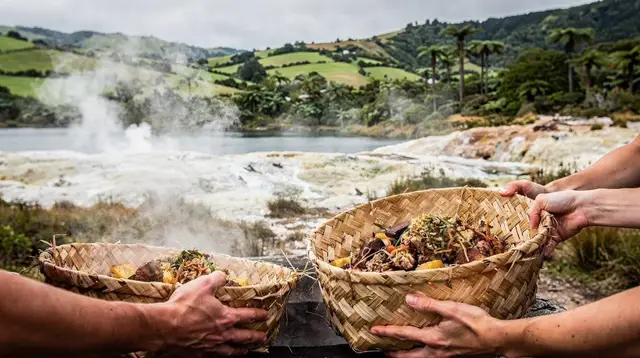
A traditional hāngī is cooked in a pit dug into the ground, lined with heated stones, and covered to steam-cook meat and vegetables for several hours. In Rotorua specifically, several venues take advantage of the geothermal ground itself, cooking food with natural steam rather than buried coals and stones — a technique used daily in the kitchens of Whakarewarewa village. The evening operators generally serve buffet-style hāngī to match their group sizes, while the technique and result are broadly similar across venues: slow-cooked, smoky, tender meat and vegetables served as a shared meal after the performance. For more on how the cooking method itself works and where else in town you can eat one outside an evening package, see our guide to what a hāngī is and where to eat one.
Group size and how staged it feels
If you dislike large tour groups, this is the variable to weigh most heavily. Te Pā Tū and Tamaki run at scale most nights, which keeps availability high but also means bigger buses and bigger concert halls. Mitai and Te Puia’s evening programme tend to feel a size down from that. Whakarewarewa’s daytime guided walks are the smallest and most self-paced of the group, simply because it is a walking tour of a real neighbourhood rather than a seated concert format. None of this is fixed — nightly numbers vary by season and by how many buses an operator runs that night — but it is the pattern worth asking about when you book if group size matters to you. Most evening operators include return transport, which also helps if you are getting around Rotorua without a car.
Making sense of the haka and the welcome
Every one of these evenings opens with some version of a formal welcome, and most build in a haka challenge at the point of arrival — historically a way of establishing whether visitors came in peace, now a piece of staged theatre with real cultural weight behind it. It is worth understanding what a haka is and is not before you go, since it is easy to read it purely as a performance of aggression. Our explainer on what the haka actually means covers the different forms and their purposes, and our guide to Māori cultural etiquette in Rotorua covers what is expected of visitors during a pōwhiri-style welcome, from choosing a “chief” to represent your group to how to receive a hongi.
Which one fits your itinerary
If you are in Rotorua for a single evening and want the most complete, highest-production package, Te Pā Tū or Tamaki deliver the fullest theatrical version — book a three-hour evening cultural tour including performance and hāngī dinner and expect a full bus-to-bus experience. If you would rather combine the evening with something you would otherwise need a separate outing for, Mitai’s glowworm walk folds that in. If your priority is the geothermal side of Rotorua, pairing daytime access to the Te Puia valley — or an afternoon geothermal outing such as an eco-thermal afternoon tour of the geysers and mud pools — with Te Puia’s night programme keeps the geothermal theme continuous through the day.
And if you have more than one day, treat a visit to Whakarewarewa Living Māori Village or a walk through Ōhinemutu as the daytime counterpart to whichever evening hāngī you book, rather than a substitute for it. Rotorua’s museum and Government Gardens make an easy midday stop to pair with either, and our guide to the Rotorua museum and Government Gardens covers what’s there.
For context on where an evening like this fits into a wider stay, our guides to how many days to spend in Rotorua and Rotorua with kids cover how to slot a cultural evening around geothermal parks, adventure activities and rest days, and our two-day Māori culture itinerary builds a full short stay around exactly this pairing of daytime village visits and one evening hāngī. If you are weighing where in Te Arawa history all of this sits, our history of Te Arawa in Rotorua is useful background before you book, and for a wider sense of how tourism sits alongside daily life in the town, our piece on overtourism in Rotorua is worth reading.
For choosing between the geothermal parks themselves on the days either side of your evening, see which geothermal park to choose, and for where to base yourself for a stay built around evenings like these, our guide to where to stay in Rotorua covers proximity to the main venues.
Rotorua cultural evenings: frequently asked questions
Which Rotorua Māori cultural evening is the most authentic?
Authenticity depends on what you mean by it. Whakarewarewa is a living village where Tūhourangi Ngāti Wāhiao residents actually live and cook, so what you see during the day is daily life, not a re-enactment. The evening hāngī-and-performance formats at Te Pā Tū, Tamaki, Mitai and Te Puia are staged experiences, produced by Te Arawa operators and performed by Māori guides and performers, but built around a fixed programme for visitors rather than an unscripted household. If you’re wondering whether Rotorua’s tourism infrastructure feels overdone more broadly, see our take on whether Rotorua is touristy.
How much do Rotorua Māori cultural evenings cost?
Prices vary by operator, season and whether transport and a full hāngī dinner are included, so no fixed figure is reliable here. As a rough guide against the destination’s daily budget bands, a hāngī evening sits closer to the mid-range to upper end of a day’s spending than the routine budget figure. Check current pricing directly with the operator or through the booking link. For how a hāngī evening fits into a broader daily budget, see our guide to Rotorua on a budget.
How long does a hāngī dinner evening last?
Most of these evenings run around three hours from pickup or arrival to drop-off, covering a welcome ceremony, a cultural performance, the hāngī meal, and return transport where included. Te Puia’s evening programme, Te Pō, tends to run somewhat longer because it also includes time in the geothermal valley after dark. If you haven’t spent time around an active geothermal area after dark before, our guide to staying safe around Rotorua’s geothermal areas is worth a read first.
Is Whakarewarewa village the same as a hāngī dinner show?
No. Whakarewarewa Living Māori Village is a residential village you can visit by day, with steam cooking, guided walks and a cultural performance, but it is not structured as an evening hāngī dinner package in the way Te Pā Tū, Mitai, Tamaki or Te Puia’s evening programme are. Treat it as a different kind of visit rather than a direct substitute. If you’d rather explore what else is on the menu around town, our guide to Rotorua food and drink covers the wider options.
Can I do a Māori cultural evening as a cruise ship passenger arriving in Tauranga?
Yes, several operators run shore excursions timed to cruise ship schedules that combine transport from Tauranga with a Rotorua cultural or geothermal visit, though a full evening hāngī format depends on how much time your ship allows in port. Check the excursion’s return time against your ship’s departure before booking. For more on making the most of a single port day, see our guide to a cruise ship day in Rotorua from Tauranga.
Do I need to book Rotorua cultural evenings in advance?
Booking ahead is sensible, particularly in the summer months and around school holidays, since these evenings run on fixed nightly departures with limited seats rather than walk-up availability. Operators, schedules and inclusions change, so confirm current details before you travel. Building one of these evenings into a longer stay is easier with a full multi-day itinerary planned ahead of time.
Are these Māori cultural evenings suitable for children?
Most are family-friendly and welcome children, with the haka and welcome ceremony often the part kids remember most. The later evening timing and the length of some programmes are worth weighing against a young child’s bedtime, and a few operators offer earlier or shorter formats worth asking about directly. If you’re planning a longer family stay, our three-day Rotorua itinerary for kids builds a fuller schedule around evenings like these.
Māori culture & heritage tours on GetYourGuide
Verified deep-linked GetYourGuide tours. Book through these links and we earn a small commission at no cost to you.
Photos show the destination, not the operator's own images.