Rotorua Highlights in One Tour: What's Really Covered
What does a Rotorua highlights tour actually include?
Most combine one geothermal park (usually Te Puia or Wai-O-Tapu), one Māori cultural stop, and a walk through the Redwoods, over roughly six to eight hours. They rarely cover more than one geothermal site properly, and Whakarewarewa Village and Te Puia are usually treated as alternatives, not both.
What a “Rotorua highlights” itinerary is built from
Search for a Rotorua highlights tour and most listings promise the same three ingredients: a geothermal park, a Māori cultural experience, and a walk through native or planted forest. It’s a reasonable shortcut for a single day, because those three things sit within a short drive of each other and none of them takes an entire day on its own. But “highlights” is doing some quiet editing. Rotorua’s geothermal system alone spans several distinct sites — see Rotorua’s geothermal parks compared — and a combo tour only has room for one of them. The same goes for the cultural stop: Te Puia and Whakarewarewa Village are two different places with two different formats, and most itineraries pick one, not both.
This matters less as a complaint and more as a planning fact. A one-day combo tour is a genuinely efficient way to see a cross-section of Rotorua if you only have a single day. It’s a poor way to see everything the region is known for. The rest of this page breaks down what each stop typically covers, what gets left off the itinerary, and how to tell from a tour listing which version of each stop you’re actually getting.
The geothermal stop: one park, not the family
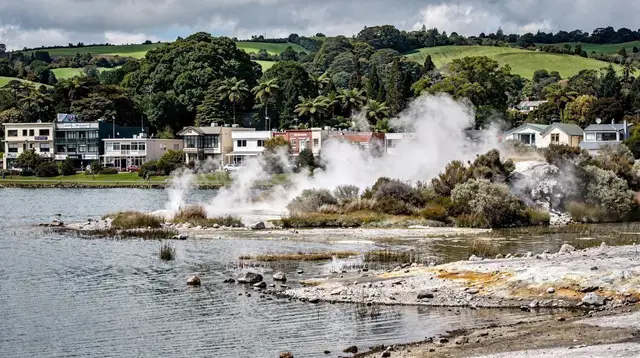
Every combo tour includes a geothermal component, because it’s the reason Rotorua exists as a destination — the whole city sits inside the Taupō Volcanic Zone, which is why steam rises from drains and the air carries a sulphur smell downtown (more on that in why Rotorua smells of sulphur). But “geothermal” on a tour listing can mean several different places, and they’re not interchangeable.
- Te Puia, inside the Whakarewarewa valley, combines geothermal features — including Pōhutu, the most reliable big geyser in the Southern Hemisphere — with a national Māori arts institute, so it often does double duty as both the geothermal and the cultural stop on a combo itinerary.
- Wai-O-Tapu, about 27 minutes south of the city, is a self-guided walking loop past coloured pools including the Champagne Pool, plus the Lady Knox Geyser, which is set off each morning at a fixed time. Tours that include Wai-O-Tapu are usually built around that morning slot.
- Waimangu Volcanic Valley is a walk-through valley rather than a park with a single centrepiece — it’s the only geothermal system in the world with a known birth date, the 1886 Tarawera eruption, and it includes Frying Pan Lake and Inferno Crater without a scheduled eruption to build a timetable around.
- Hell’s Gate, northeast of town, is the most visibly active site and the only one where a mud bath is part of the visit, rather than just viewing.
A combo tour picks one. If the listing just says “geothermal wonderland” without naming the site, that’s worth clarifying before booking, because a Wai-O-Tapu morning and a Waimangu afternoon are genuinely different experiences, not two names for the same walk. For a side-by-side, see Wai-O-Tapu’s visiting guide and the general park comparison linked above. If your priority is the geyser specifically, check when Pōhutu erupts before assuming any combo tour’s timing lines up with it.
a combined half-day covering both Wai-O-Tapu and Waimangu by boat is one of the few itineraries that actually gets you two geothermal sites rather than one, though it trades out the forest and cultural stops to do it.
The cultural stop: village visit or arts institute, rarely both
The second fixed ingredient is a Māori cultural component, and here the two most common options work quite differently. Whakarewarewa Village is a living settlement — Tūhourangi Ngāti Wāhiao families still live and cook there using geothermal steam, and a visit is a guided walk through an inhabited place. Te Puia is the New Zealand Māori Arts and Crafts Institute: carving and weaving schools, cultural performances, and the geothermal features mentioned above, all on one site with a more formal, institutional structure.
Combo tours built around Te Puia get geothermal and culture in a single stop, which is efficient — see a Te Puia visit paired with a rejuvenation-focused itinerary for that combination. Tours built around Whakarewarewa Village lean more toward the lived-in, resident-guided side, closer to what’s described in Te Arawa’s history in Rotorua. Either way, don’t expect both in one day alongside geothermal and forest — the two cultural venues are each substantial enough that combining them with everything else stretches the day past what a single tour bus schedule allows.
What’s often missing from the daytime combo format specifically is the hāngī and evening performance. A hāngī — food cooked in a pit oven, often steam-finished in Rotorua rather than earth-covered in the traditional style — is usually sold as its own evening package at venues like Te Puia, Mitai, or Tamaki Māori Village, not folded into a daytime sightseeing tour. If a shared meal and performance matter to your trip, treat it as a separate booking; see hāngī: what it is and where to eat one and Rotorua’s cultural experiences compared for how the evening options differ from the daytime village or institute visits. A quick look at Māori cultural etiquette in Rotorua is worth it either way, since a guided visit still asks something of the visitor.
The forest stop: a loop, not the network
The third fixed stop is the Redwoods — Whakarewarewa Forest, planted with Californian sequoias from 1901 and now one of the more extensive mountain biking networks anywhere, with a canopy walkway open by day and lit at night. On a combo tour, this stop is almost always the shortest of the three: a 30- to 60-minute loop walk, sometimes swapped for the treewalk if timing allows, rather than any of the longer trails.
That’s a reasonable trade if the forest is a add-on rather than the point of your day. It’s a poor fit if you actually want to ride the trail network or spend real time under the canopy, in which case the forest deserves its own half-day — see the treewalk by day or by night and mountain biking in the Redwoods for what a dedicated visit looks like versus a tour bus stop. a Redwoods walk paired with a Māori village visit gives the forest slightly more room than tours that also try to fit in a geothermal park on the same day.
What a typical highlights tour leaves off entirely
Because the format is built around three fixed stops in one day, several well-known Rotorua features rarely appear on a combo itinerary at all:
- Mount Tarawera — access is guided and controlled by the iwi who own the mountain, and a proper visit is its own booking, not a add-on stop.
- Hobbiton — around 50 minutes away near Matamata, it’s a separate half-day product; see getting from Rotorua to Hobbiton if you want to add it as its own day.
- A second geothermal park — as covered above, one is the norm.
- Lake activities — cruises or kayaking on Lake Rotorua or Lake Tarawera are usually separate bookings, not folded into a land-based combo.
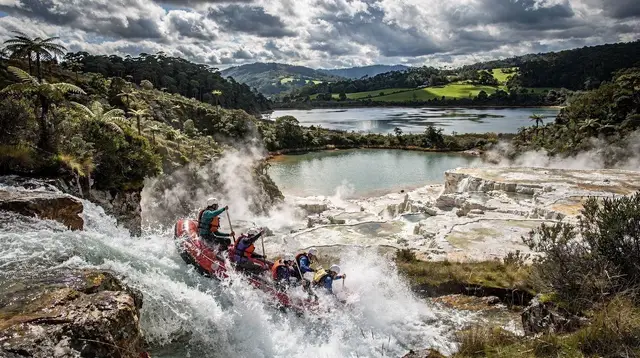
- Whitewater rafting on the Kaituna — a physically separate activity with its own gear and timing, not compatible with a sightseeing bus schedule.
None of this makes combo tours a bad choice — it just means “highlights” describes a curated cross-section, not a complete list.
Comparing common combo formats
| Format | Geothermal stop | Cultural stop | Forest stop | Typical length |
|---|---|---|---|---|
| Geothermal + culture combined | Te Puia (features included) | Te Puia (same site) | Often none or brief | 4–5 hours |
| Wai-O-Tapu + Waimangu | Both sites | None | None | 5–6 hours |
| Full highlights loop | One park (varies) | Village or Te Puia | Redwoods loop | 6–8 hours |
| Adventure-leaning combo | Optional/brief | Optional/brief | Skipped for activities | Varies |
Exact stops and hours vary by operator and season, so treat this as a shape rather than a fixed schedule — check the specific listing for what’s included before comparing price.
Who this suits, and who should split it up
A single combo tour makes sense if you have one day in Rotorua and want a guided, no-driving introduction to the geothermal, cultural and forest sides of the region without deciding between them yourself — a full-day Rotorua highlights tour from Tauranga is built for exactly that case, useful if you’re basing yourself on the coast or arriving by cruise ship (see a cruise-ship day in Rotorua from Tauranga — though note that link only works if the itinerary matches your arrival window).
It’s a weaker fit if you have two or more days and want to actually compare geothermal parks, take in a hāngī and performance properly, or spend more time in the Redwoods than a bus schedule allows. In that case, look at how many days to spend in Rotorua and consider splitting the single combo day into a two-day geothermal-focused itinerary plus a separate half-day for forest and culture — Rotorua’s two-day itinerary lays out one version of that split, versus the tighter one-day itinerary built around the same trade-offs a combo tour makes for you.
If your interest leans toward adventure rather than sightseeing pace, a private, activity-focused tour swaps some of the standing-and-viewing time for more hands-on stops, and a half-day eco-thermal afternoon tour is a shorter alternative if a full day feels like too much. Whichever format you pick, it’s worth reading guided tours versus self-drive in Rotorua first, since the same three stops cost less in entry fees driven yourself, at the expense of the planning and driving a combo tour hands off to someone else.
For a broader sense of what’s on offer beyond sightseeing loops, Rotorua’s sightseeing and day tour category lists the range, and things to do around geothermal parks specifically is a useful next stop if one park on a combo tour leaves you wanting to see the others.
Rotorua highlights in one tour: frequently asked questions
Is one combo tour enough to see Rotorua’s geothermal features?
It covers one park well, not the range. Wai-O-Tapu, Waimangu and Hell’s Gate each show different geothermal features, and a single-day combo tour can only fit one of them alongside the cultural and forest stops.
Do these tours include Te Puia and Whakarewarewa Village?
Usually just one. Te Puia and Whakarewarewa Village sit in the same valley but are separately run, and most combo itineraries pick one rather than both, since each visit already takes an hour or more.
How much of the Redwoods forest do you actually see on a combo tour?
A short walking loop, not the full network. The Redwoods has an extensive trail and mountain biking network; a combo tour typically allots 30 to 60 minutes for a loop walk or the treewalk, which is a fraction of what the forest offers.
Does a highlights tour include a hāngī meal?
Not usually, unless it’s specifically an evening cultural package. Daytime combo tours focus on sightseeing; a hāngī and cultural performance is more often a separate evening booking at Te Puia, Mitai or Tamaki Māori Village.
Is Wai-O-Tapu or Waimangu included, and does it matter which one?
It depends on the operator, and it does matter. Wai-O-Tapu has the Champagne Pool and the timed Lady Knox Geyser; Waimangu is a walk-through valley with no scheduled eruption. They’re different formats, so check which one a tour actually lists before booking on the word “geothermal.”
Can you skip the combo tour and do it self-drive?
Yes, and it often costs less in entry fees since you choose sites yourself, but it takes more planning and a rental car. A combo tour trades flexibility for a fixed itinerary and included transport between stops that are spread across different roads out of town.
Is Mount Tarawera or Hobbiton part of a Rotorua highlights tour?
No, they’re separate products. Mount Tarawera access is guided and iwi-controlled, and Hobbiton is roughly 50 minutes away near Matamata; neither fits inside a same-day combo built around geothermal, culture and forest.
Who is a one-day highlights tour a poor fit for?
Anyone who wants to properly compare geothermal parks, do a hāngī and performance, and walk more of the Redwoods trail network. That combination needs at least two days rather than one combined tour.
Sightseeing day tours on GetYourGuide
Verified deep-linked GetYourGuide tours. Book through these links and we earn a small commission at no cost to you.
Photos show the destination, not the operator's own images.