Rotorua in 2 Days: Steam, Culture, Forest and Water
Two days is the shortest stretch of time that lets Rotorua show both of its sides without feeling rushed: the geothermal and cultural core on one day, the forest and water on the other. It’s also a genuinely workable plan without a rental car, since the two anchor sites outside town — Wai-O-Tapu and the Kaituna River — are both normally reached by shuttle or tour transport rather than self-drive, and everything inside town is walkable or a short taxi ride.
This plan assumes you’re based in central Rotorua, arrive by morning on day one, and leave sometime on day two or the following morning. If you have an extra day to spare, see how many days in Rotorua actually makes sense for a fuller trip; if you’re driving yourself, the self-drive versus guided tours comparison is worth reading before you lock in a plan.
Day 1: Steam and Culture
The first day stays close to Rotorua’s defining feature — the geothermal ground it sits on — and to the living Māori culture of Te Arawa, which is not staged for visitors but continues day to day in the same neighbourhoods.
Morning: Whakarewarewa Village
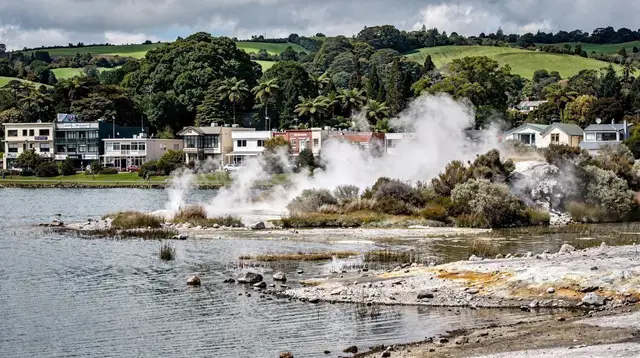
Start at Whakarewarewa Village, a few minutes from central Rotorua by taxi or local bus. This is a residential village of Tūhourangi Ngāti Wāhiao, not a recreation — people still live here, and food is still cooked in geothermal steam boxes set into the ground behind the houses. A guided walk explains how the community uses the heat, points out the active pools and steam vents, and covers the village’s history and its relationship with the neighbouring institute.
a guided walk through the living village of Whakarewarewa is the straightforward way to do this without arranging your own transport, and it gives context that’s easy to miss walking through alone. If you’d rather set your own pace, the self-guided geothermal trails around Whakarewarewa cover the wider valley on foot. Right next door is Te Puia, the national institute of Māori arts and crafts, where Pōhutu — the most reliable geyser in the Southern Hemisphere — erupts once or twice an hour. The difference between Te Puia and the living village trips up a lot of first-time visitors, since they sit on the same road and share the same valley but are separately run.
Midday: lunch and transfer south
Eat in Rotorua before heading out — Wai-O-Tapu itself has limited food options. This is also a good point to book a hāngī if you haven’t already; what a hāngī actually is and where to eat one is worth reading before you commit to an evening slot, since the quality and format vary between venues.
Afternoon: Wai-O-Tapu
Wai-O-Tapu sits about 27 km south of Rotorua on State Highway 5. Without a car, this is the one stretch of the two days where a tour genuinely does the job a rental car would otherwise do: it handles the return trip and, in most cases, times your visit around the Lady Knox Geyser, which is set off each morning with a surfactant rather than erupting on its own schedule — worth knowing so you don’t arrive expecting a natural event.
a half-day tour to Wai-O-Tapu with transport from Rotorua covers the park’s main loop, including the Champagne Pool and the Devil’s Bath, both coloured by mineral deposits rather than dye. If you’d rather buy park entry alone and arrange your own shuttle, a Wai-O-Tapu entry ticket is the other option. The full visiting guide to Wai-O-Tapu covers walking times and what each part of the loop actually looks like, and why Rotorua smells of sulphur explains the hydrogen sulphide that becomes obvious the moment you step out of the car — a smell every geothermal park in the region shares.
If you’d rather not choose between Wai-O-Tapu and the wider geothermal country, a longer combined day covering Wai-O-Tapu, Waimangu and Te Puia exists as a single booking, though it runs closer to a full day than a half day and would need to replace the morning village visit above.
Evening: hāngī and cultural performance
Round off the day back in Rotorua with a hāngī dinner and cultural performance — most operators include hotel pickup, which matters if you’re relying on transfers rather than driving. an afternoon geothermal visit paired with a hāngī and cultural performance is one way to combine the two rather than booking them separately. For background on what you’re watching rather than just what you’re eating, what the haka actually means and the wider cultural etiquette worth knowing in Rotorua both help the evening land as more than a show. The history of Te Arawa in Rotorua is a longer read for anyone who wants the fuller context afterwards.
Day 2: Forest and Water
The second day swaps geothermal ground for green — a planted forest just outside town, and the river system that drains Rotorua’s lakes toward the Bay of Plenty.
Morning: the Redwoods
The Redwoods — Whakarewarewa Forest is a short taxi ride or, for the fitter option, a walkable distance from parts of central Rotorua. The California redwoods here were planted in 1901 as an experiment in fast-growing timber and now tower well above the native bush that grew up around them. Ground-level walking tracks are free and well signed; the elevated canopy walkway is a separate paid experience, running during the day and, with different lighting, after dark. Redwoods Treewalk by day or by night breaks down which version suits which kind of visit.
The forest is also one of the world’s better-known mountain biking networks — mountain biking in the Redwoods covers trail options if that interests you, and the wider list of free walking tracks around Rotorua points to nearby alternatives if you want a longer or shorter loop.
Midday: back toward the water
From the Redwoods, head back toward Rotorua or arrange a shuttle out to the Kaituna River area — most rafting and kayaking operators on the Kaituna include pickup from central Rotorua accommodation, which removes the need for your own transport for this stretch.
Afternoon: Okere Falls and the Kaituna River
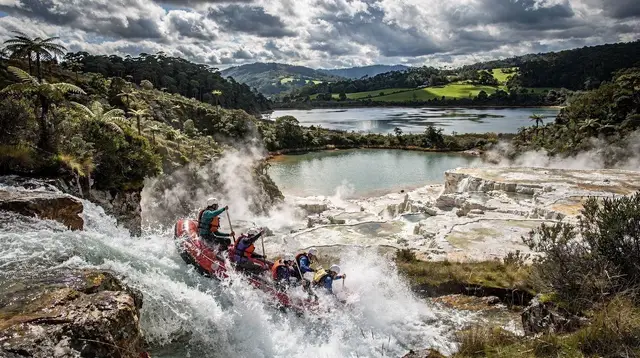
Okere Falls sits on the Kaituna River, where Tutea Falls — a 7-metre drop — is the highest waterfall commercially rafted anywhere in the world. You don’t need to raft it to see it: a walking track along the gorge gives clear viewpoints of the falls and the narrower stretches of river above and below. If you do want to get on the water, the guide to rafting the Kaituna and the broader comparison of which river to raft around Rotorua cover what to expect and how the trip is usually run, transport included.
Evening: back in town
End the second day back in central Rotorua, along the lakefront or through Ōhinemutu, the Ngāti Whakaue village built directly into the town, where St Faith’s Church has a Christ figure etched into a window overlooking the lake. It’s a quiet way to close two days that started in steam and ended by water, all within reach of town.
Two days at a glance
| When | Day 1 — Steam and Culture | Day 2 — Forest and Water |
|---|---|---|
| Morning | Whakarewarewa Village + Te Puia | The Redwoods forest walk or Treewalk |
| Midday | Lunch in Rotorua, transfer south | Return to town or transfer to the Kaituna |
| Afternoon | Wai-O-Tapu geothermal park | Okere Falls and the Kaituna River |
| Evening | Hāngī and cultural performance | Lakefront and Ōhinemutu |
| Transport | Half-day tour with pickup | Local shuttle or short taxi rides |
Budget for these two days
These are per-person, per-day order-of-magnitude ranges rather than fixed prices, since entry fees, tour inclusions and accommodation standards vary.
| Style | Approximate daily spend | What it typically covers |
|---|---|---|
| Backpacker | ~150 NZD | Hostel bed, self-guided entry to one park, basic meals |
| Mid-range | ~350 NZD | Private room, one guided tour with transport, sit-down meals |
| High-end | ~700 NZD | Upgraded stay, private or small-group tours, table-service dining |
Prices are quoted with New Zealand’s 15% GST already included, so the figure you see is the figure you pay, and tipping isn’t expected on top of it.
Rotorua in 2 Days: Frequently Asked Questions
Is 2 days enough for Rotorua?
It’s enough to see one geothermal park properly, walk through a living Māori village, and spend a morning or afternoon in the Redwoods. It is not enough to also add Hobbiton, Waitomo, or a full day at Lake Taupō — those push the trip toward 3 to 5 days.
Do I need a rental car for this itinerary?
No. Whakarewarewa Village and the Redwoods are a short taxi or local bus ride from central Rotorua, and Wai-O-Tapu, about 27 km south, is normally visited by a half-day tour that includes hotel pickup and drop-off.
Which geothermal park should I choose if I only have time for one?
Wai-O-Tapu covers the widest range of geothermal features in a single visit, including the Champagne Pool and the Lady Knox Geyser, which erupts on a set morning schedule. Whakarewarewa, split between the living village and Te Puia, adds the cultural layer that Wai-O-Tapu does not have. The geothermal parks compared guide covers the rest of the region’s options.
Can I see both Whakarewarewa Village and Wai-O-Tapu on the same day?
Yes, if you start early. The village visit runs a couple of hours, and Wai-O-Tapu is usually a half-day including transport, so the combination fills a full day but leaves the evening free in town.
What should I wear for the geothermal park and the forest walk?
Closed, flat shoes for both — geothermal ground can be uneven and slippery, and forest tracks can be muddy after rain, which falls year-round. Add sun protection even on a cool day, since the UV level in New Zealand runs high.
Is the Redwoods forest walk free?
The ground-level walking tracks through the Redwoods are free and open daily. The elevated canopy walkway and the night-lit Treewalk are separate, paid experiences within the same forest.
Will it still be worth it if it rains?
Rotorua gets rain year-round, and geothermal parks are often considered better in the rain — steam shows up more dramatically against cool, wet air. The Redwoods forest also holds up well under light rain, since the canopy provides some shelter.
If two days leaves you wanting more, the natural next step is a third day added on either side — see the full 3-day Rotorua itinerary for how that extra day is usually spent, or check getting around Rotorua without a car for the wider transport picture beyond these two days.
tours.2 days
Verified deep-linked GetYourGuide tours. Book through these links and we earn a small commission at no cost to you.
Photos show the destination, not the operator's own images.