The Bath House That Built Rotorua's Economy on a Smell
Arriving in the smell
The first time I walked out of a car in Rotorua, the smell hit before anything else did. Sulphur, faint but unmistakable, drifting up from a storm drain near the Government Gardens. My instinct was to wonder how anyone builds a tourist economy on that. Then I found out someone already had, more than a century ago, and did it deliberately.
I went looking for the story because the smell kept following me around town, and because a strange brick building sits at the edge of the Gardens looking far too grand for what I assumed was just a park pavilion. That building is the Bath House, and it turns out to be the reason Rotorua exists as a destination at all.
An empire that came to bathe
Rotorua’s tourism did not start with geysers or Maori cultural performances as the drawcard, at least not in the way it is marketed now. It started with medicine, or what passed for medicine in the 1880s. European doctors of the era genuinely believed that soaking in hot, mineral-laden water could treat rheumatism, gout, arthritis and various skin conditions. Spa towns across Europe had been built on the same idea for a century already. When colonial administrators realised the Rotorua area sat on a natural supply of exactly that kind of water, they saw an opportunity that fit a pattern they already knew.
By the 1880s, Rotorua was already the country’s leading tourist drawcard, and the government leaned into it. The state built the Bath House in 1908, in the Government Gardens beside Lake Rotorua, as a purpose-built spa resort under direct government control. This was not a private hotel chasing wealthy tourists. It was a state health facility, staffed with medical officers, offering baths, douches, electric treatments and mud packs, all drawing on the geothermal water beneath the town.
What strikes me most, reading about it now, is how far people travelled for this. Patients came from across New Zealand, from Australia, and from Britain itself. In an era before antibiotics and modern rheumatology, a course of treatment at a government-run spa on the far edge of the British Empire was a genuine medical option, marketed with the same seriousness as any hospital referral. The brochures of the period read like prescriptions, not holidays.
What the water was supposed to cure
The specific claims varied by decade, but the general pitch stayed consistent: the minerals in the water, and particularly the sulphur, were framed as therapeutic rather than merely pleasant. Rheumatic and arthritic patients were the biggest group, but the Bath House also treated skin conditions, and for a period ran treatments modelled on continental European spa medicine imported almost wholesale.
This is worth sitting with, because it inverts how I now think about the smell. The hydrogen sulphide that makes some visitors wrinkle their nose near Kuirau Park or the town’s storm drains was not a side effect the tourism industry had to manage. It was the whole product. Officials and doctors of the period were not apologising for the smell, they were charging for it.
The wider geothermal landscape around the Bath House era included working thermal villages too. Whakarewarewa Village, home to Tuhourangi Ngati Wahiao, already hosted visitors keen to see geothermal life at close range, cooking with steam and bathing in natural pools, well before the government spa existed in its 1908 form. The Bath House added a formal, medicalised layer on top of a place that Te Arawa communities had already been living with, and drawing income from, for generations. If you want the fuller version of that longer history, it is worth reading through Te Arawa history in Rotorua rather than treating the Bath House as where the story begins.
The town that grew around the smell
Once Rotorua had an international reputation as a cure destination, the rest of the town’s infrastructure followed the same logic. Hotels, transport links and later a museum went up to serve people who had come for weeks of treatment, not a weekend. The Bath House building itself later became home to the Rotorua Museum, which is a strange kind of continuity: a building constructed to treat bodies with geothermal water became a building preserving the story of the town that geothermal water created.
It also means the timing of the 1886 Tarawera eruption sits uncomfortably close to the spa story. The eruption destroyed the Pink and White Terraces and the village of Te Wairoa only two decades before the Bath House opened, yet the region’s tourism reputation recovered and, if anything, the spa era that followed absorbed the disaster into a broader narrative about a landscape defined by extremes. Walking through the excavated remains at Te Wairoa now gives a clearer sense of what was lost, and of how quickly the town rebuilt its tourism identity around a different geothermal attraction instead.
a guided walk through the excavated ruins of Te Wairoa puts the eruption and the spa-era rebuilding into the same afternoon, which is the closest I have found to feeling both halves of that history at once.
By the interwar period, the cure-based framing had started to fade as medical fashion moved away from spa treatments generally, not just in Rotorua. But the economic pattern it established did not disappear. The town kept marketing its geothermal features, only the framing shifted from medical treatment towards scenery, culture and recreation.
What is left of the Empire cure today
The Bath House building has been closed since 2016 for earthquake strengthening, with reopening happening in stages, so I would not plan a visit around getting inside it without checking current access first. What remains fully open is the surrounding Government Gardens, and the wider pattern of geothermal tourism the Bath House era set in motion.
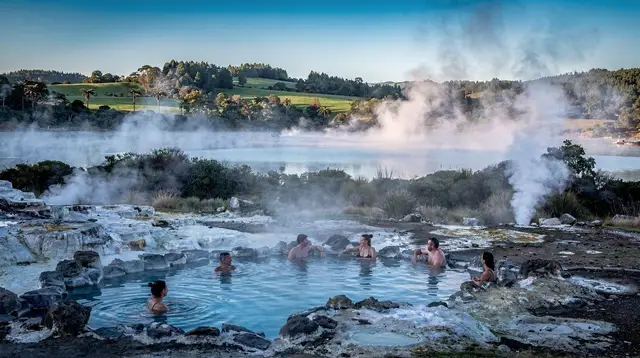
Commercial hot pools are the most direct descendant, though they are recreational now rather than medical. If you want to understand today’s options without wading through marketing copy, the Rotorua hot pools guide and the separate rundown of free hot springs around Rotorua are more useful starting points than anything I could summarise here. For a spa experience closer in spirit to the Bath House’s mineral-bath focus, it is worth reading what the Polynesian Spa expects from visitors before booking.
an afternoon geothermal tour is a reasonable modern equivalent of the old cure-seeker’s itinerary, minus the medical framing, and it pairs well with a proper soak afterwards.
The wider geothermal landscape that made the Bath House possible has not gone anywhere either. Wai-O-Tapu and Waimangu Volcanic Valley sit on the same volcanic system, and seeing them helps explain why Edwardian doctors were so convinced the water here was special.
a boat tour through Wai-O-Tapu and Waimangu covers both in a single day if the underlying geology, rather than the cure history, is what draws you in.
If you would rather finish the day the way the original patients did, with a long soak, a combo that adds a hot pool session with a sauna is worth building into an itinerary.
a rafting and hot pool combo with a free sauna is a strange but honest bookend to a day spent thinking about Edwardian bath culture, since it ends the same way the cure-seekers’ day did, submerged in the same water.
None of this makes Rotorua a spa town in the 1908 sense any more. But every time I catch that sulphur smell now, I think less about drains and more about the doctors who once wrote prescriptions for it, and about a town that figured out, quite deliberately, how to sell what most places would try to hide. For planning the rest of a visit around the smell rather than in spite of it, why Rotorua smells of sulphur and an honest look at whether Rotorua is too touristy are worth reading alongside this one, along with a wider honest verdict on Rotorua if you are still deciding whether the town is for you.
Frequently asked questions about Rotorua’s Bath House and spa history
When was the Rotorua Bath House built?
The Bath House opened in 1908 in the Government Gardens, built by the state as a formal spa resort offering mineral baths and medical treatments. It is closed for seismic strengthening and is being reopened in stages, so check current access before planning a visit.
Why did people travel to Rotorua for their health?
From the late 1800s, colonial medicine believed in taking the waters, and Rotorua’s naturally hot, mineral-rich springs were marketed as treatment for rheumatism, arthritis, gout and skin conditions. Patients came from across New Zealand and further afield in the British Empire.
Is Rotorua’s spa tourism history connected to its smell?
Directly. The hydrogen sulphide smell that many first-time visitors notice comes from the same geothermal system that made the water hot and mineral-rich in the first place. The town’s earliest tourism economy was built on selling access to that smell as a cure.
Can you still visit the Bath House building today?
The Bath House building itself has been closed since 2016 for earthquake strengthening and is reopening by stages, so its current use is best checked directly rather than assumed. The Government Gardens around it remain open.
What happened to Rotorua’s spa industry after the Bath House era?
Medical fashions moved on from mineral-water cures through the twentieth century, and Rotorua’s tourism economy diversified into Maori cultural experiences, geothermal parks, and adventure activities, alongside newer commercial hot pool venues.
Are Rotorua’s hot pools today the same as the old Bath House treatments?
Not directly. Today’s commercial hot pools are recreational rather than medical, though several draw on the same geothermal aquifer that supplied the original Bath House and its Edwardian bathhouse culture.
Hot pools & spa experiences in Rotorua
Verified deep-linked GetYourGuide tours. Book through these links and we earn a small commission at no cost to you.
Photos show the destination, not the operator's own images.