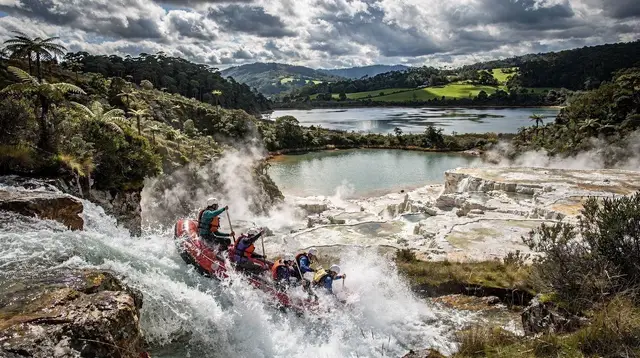
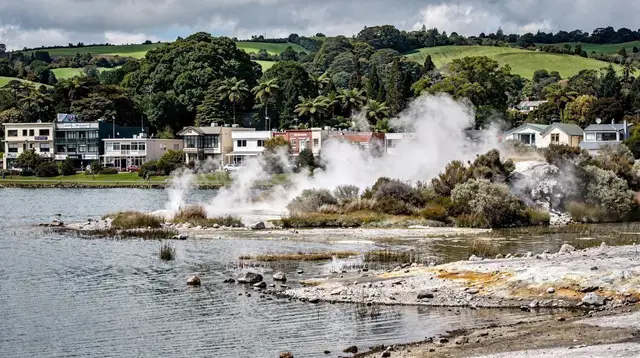
What Overtourism Looks Like in Rotorua
The first time the scale of it struck me wasn’t at a geyser. It was on a Tuesday morning outside a café near the lakefront, watching three coach tours unload within about ten minutes of each other, into a town centre that, on paper, holds fewer people than a mid-sized suburb. Rotorua has been the country’s leading tourist draw since the 1880s. That’s not a recent marketing line — it’s roughly a century and a half of visitors arriving to see the same steam, the same lake, the same Te Arawa villages that people still actually live in. The maths of that is worth sitting with before I get into where it shows.
A small city carrying a big number
Rotorua has around 60,000 residents. It isn’t Auckland, and it isn’t set up like a city built to absorb crowds — it’s a lakeside town with a compact centre, a handful of geothermal reserves nearby, and a road network that wasn’t designed for coach-tour scheduling. So when I talk about overtourism here, I don’t mean the whole place feels overrun. Most of Rotorua, most days, feels ordinary — people doing errands, kids at school, steam drifting out of a drain on a residential street like it’s nothing, because to the people who live there, it is nothing. The pressure is real, but it’s concentrated, not evenly spread.
Where it concentrates is predictable once you’ve spent time here. The car park at Whakarewarewa Village fills fast on a clear morning. Te Puia times entry around bus arrivals, which tells you something about volume on its own. Ōhinemutu, a working Ngāti Whakaue village with its own marae and the St Faith’s church people still worship in, gets a steady trickle of visitors wandering through with cameras, some of whom clearly don’t register that it isn’t a museum. The Redwoods trails near town show the wear of foot and bike traffic on a network built for a fraction of today’s numbers. And on days a cruise ship docks in Tauranga, the road in from that direction carries a visible spike of day-trippers all converging on the same two or three attractions within the same four-hour window.
None of that is a crisis. It’s closer to a low, steady friction — a town whose economy depends on visitors, feeling the edges of what that dependence costs.
What the city, and Te Arawa, actually say about it
What’s changed in the years I’ve been paying attention isn’t the volume so much as who’s setting the terms. Te Puia and Whakarewarewa Village aren’t passive backdrops that tourism happened to; they’re run by the same iwi whose people live in and around them, on iwi land, with entry structured deliberately — timed groups, guided routes, no wandering into someone’s actual front yard uninvited. Access to Mount Tarawera is guided-only for the same reason: the mountain belongs to the iwi, and that’s not a rule dressed up as an experience, it’s ownership being exercised. Lake Rotokākahi is tapu and closed to swimming and boating outright — no negotiation, no premium ticket that gets you around it.
The national framing for all of this is the Tiaki Promise, the visitor commitment New Zealand asks people to make before they land: care for land, sea, and culture, travel safely, respect the people and places you’re in. It sounds like a slogan until you watch it play out at a place like Ōhinemutu, where the difference between a respectful visit and an intrusive one is basically whether someone read the signage and kept their voice down near the urupā. The city’s own tourism messaging in recent years has leaned harder into “spread out, slow down” than it used to — fewer campaigns pushing the same three landmarks, more content pointing at Hamurana Springs, Okere Falls, or a quiet paddle on Lake Rotoiti instead.
Where I’ve landed on visiting without adding to it
I don’t think the answer is to feel guilty about coming. Rotorua’s tourism economy pays people’s wages, and a lot of the cultural experiences on offer exist because there’s an audience for them — Te Puia trains carvers and weavers partly on ticket revenue. The honest answer is closer to being deliberate about when and how.
Shoulder season helps more than almost anything else. Winter here isn’t cold in a way that stops you doing much, and the steam actually looks more dramatic against cold air — worth reading Rotorua in winter before writing off the season. Arriving at a geothermal park early or late in the day, rather than mid-morning when the coaches land, changes the whole feel of a visit. And there are quieter, equally real alternatives to the big three parks: Hell’s Gate sees less foot traffic than Wai-O-Tapu, and Waimangu, the valley born from the 1886 eruption, has enough space that it rarely feels crowded even on a full day.
I’ve also started favouring bookings that put money directly with the people whose land it is, rather than generic add-ons. An afternoon walk through a smaller geothermal reserve with a local guide spreads visitor numbers away from the single busiest park at the single busiest hour, and a guided stop at the buried village at Te Wairoa tends to run at a completely different pace than the peak-season crush elsewhere. Pairing two sites in one outing — say a combined visit to Wai-O-Tapu and Waimangu on the same trip — also means one transfer and one booking instead of two separate car park queues on two separate days.
The rest is smaller stuff. Reading the signs at Ōhinemutu and not filming through someone’s window. Skipping Rotokākahi entirely rather than trying to get close for a photo. Checking is Rotorua touristy and Rotorua’s honest verdict before you go, so you’re not surprised by what’s crowded and what isn’t. None of it stops tourism from existing here — nothing will, and nothing should, given how much the town depends on it. It just means the pressure lands a little more evenly, and a little more where the people who actually live here have said it’s welcome.
Overtourism in Rotorua: Questions People Ask Me
Is Rotorua too crowded to visit?
No, not as a blanket rule. Crowding concentrates at a handful of well-known geothermal parks and cultural sites, especially mid-morning and around cruise-ship days in nearby Tauranga. Most of the town and the wider region, including many lakes and smaller reserves, stays quiet even in peak season.
Which parts of Rotorua feel the most pressure?
Whakarewarewa Village, Te Puia, the Redwoods trail network, and Ōhinemutu see the heaviest foot traffic, along with the best-known geothermal parks on clear mornings. Quieter alternatives exist within a short drive of all of them.
What does the Tiaki Promise ask visitors to do?
It’s a voluntary commitment New Zealand asks travellers to make: care for the land, sea, and wildlife, respect culture and community, and travel safely. In Rotorua that translates concretely into reading site signage, staying out of areas marked tapu, and treating living villages like Ōhinemutu as homes, not exhibits.
Is it okay to visit Ōhinemutu as a tourist?
Yes, it’s open to visitors and worth seeing, including St Faith’s church, but it’s a working Ngāti Whakaue village with a marae and an urupā. Keep to public areas, don’t photograph people or homes without asking, and treat it with the same respect you’d want shown to your own street.
When is the quietest time to visit Rotorua?
Winter (June to August) and the shoulder months either side see fewer visitors than the summer peak, and early morning or late afternoon at any geothermal park avoids the coach-tour window. There’s no dead season here, just a less crowded one.
Does booking tours help or hurt overtourism?
It depends which tour and where the money goes. A booking with an operator based at a smaller or lesser-visited site, or one run directly by the iwi whose land it is, spreads visitor pressure and keeps revenue local, which is a different outcome than funnelling everyone into the same two attractions at the same hour.
Should I skip Rotorua and go somewhere less touristy instead?
Not necessarily — the geothermal activity, Te Arawa culture, and lakes here aren’t replicated elsewhere in the country, and avoiding the place doesn’t reduce pressure on it. Visiting thoughtfully, off-peak where possible, does more good than staying away.
Trip-planning essentials on GetYourGuide
Verified deep-linked GetYourGuide tours. Book through these links and we earn a small commission at no cost to you.
Photos show the destination, not the operator's own images.