Rotorua in 7 Days: The Full Volcanic Plateau Itinerary
Rotorua and Taupō sit on the same stretch of the Taupō Volcanic Zone, roughly an hour’s drive apart. That proximity is what makes this itinerary possible: seven days, two beds, and access to almost everything travellers associate with the central North Island — steaming craters, a mountain that blew itself open in 1886, a hobbit-hole film set, glowworm caves, and a full-day alpine crossing between two active volcanoes. Nobody packs a bag more than once.
This is not a rushed version of a longer trip. It’s a deliberate one: base in Rotorua for the first four nights to work through the geothermal valleys and Tarawera, then shift to Taupō for two nights to be close enough to start the Tongariro Alpine Crossing at a sane hour, before looping back through the Bay of Plenty on the last day. Expect long days outdoors, a fair amount of driving, and no shortage of sulphur in the air.
Before you drive: logistics for the week
| Day | Base | Focus |
|---|---|---|
| 1 | Rotorua | Arrival, geothermal orientation |
| 2 | Rotorua | Waimangu Volcanic Valley & Wai-O-Tapu |
| 3 | Rotorua | Mount Tarawera & the Buried Village |
| 4 | Rotorua | Hobbiton & Waitomo Caves |
| 5 | Taupō | Transfer, Huka Falls, Craters of the Moon |
| 6 | Taupō | Tongariro Alpine Crossing |
| 7 | Rotorua | Bay of Plenty side trip, departure |
Driving in New Zealand for visitors means the left-hand side of the road and, on the Rotorua–Taupō stretch, mostly open highway with occasional single-lane sections — budget more time than the map suggests if you’re not used to it. Two bases keeps packing to a minimum, but this is still a car-dependent week; there’s no practical way to reach Waimangu, Tarawera, Hobbiton or Tongariro on public transport on this kind of schedule.
Day 1: Rotorua orientation
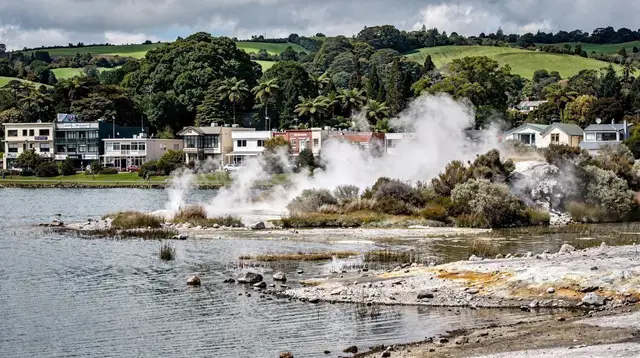
Arrive in Rotorua and spend the first afternoon getting oriented rather than rushing to the biggest sights. The town itself is part of the attraction: steam rises from storm drains and footpaths, and the smell of hydrogen sulphide is simply how the place smells. Start at Kuirau Park, a free public geothermal park with boiling pools and mud right in the middle of town, then walk to Ōhinemutu, the lakeside Ngāti Whakaue village where St Faith’s Church still has its etched-glass Christ figure looking out over Lake Rotorua.
In the afternoon, choose between Te Puia, the national māori arts institute where the Pōhutu Geyser erupts once or twice an hour, and Whakarewarewa Village, the living village where Tūhourangi Ngāti Wāhiao residents still cook with geothermal steam. Read te-puia-vs-whakarewarewa-village before deciding — they cover different ground and either works as a first-evening introduction to Te Arawa culture. If you have energy left, the Redwoods Whakarewarewa Forest canopy walkway runs after dark too.
Day 2: Waimangu Volcanic Valley and Wai-O-Tapu
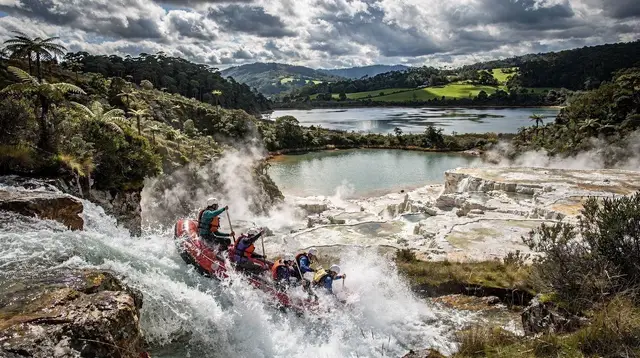
This is the geothermal day proper, and it needs most of it. Waimangu Volcanic Valley is the only geothermal system on earth with a known birthdate — the Tarawera eruption of 10 June 1886 — and walking down through it past Frying Pan Lake and Inferno Crater feels like walking through a landscape still settling. From there, Wai-O-Tapu adds the Champagne Pool and Devil’s Bath, plus the Lady Knox Geyser, which is triggered every morning at 10:15 rather than erupting on its own — check the wai-o-tapu-visiting-guide for the order that avoids doubling back on the SH5.
a combined day tour covering Wai-O-Tapu, Waimangu and Te Puia is worth considering if you’d rather not manage entry times and driving between three sites yourself. For a different angle on Waimangu, a kayak trip through the Steaming Cliffs section shows the valley from the water instead of the boardwalk. Come back into Rotorua in the late afternoon — rotorua-geothermal-parks-which-one-to-choose is a useful reference before you commit to which parks earn a return visit later in the trip.
Day 3: Mount Tarawera and the Buried Village
Mount Tarawera is the mountain behind everything you saw yesterday. It split open in 1886, killed more than a hundred people, and buried the Pink and White Terraces — once considered one of the natural wonders of the world — along with the village of Te Wairoa. Access to the mountain itself is guided only; it belongs to the iwi, and independent hiking isn’t permitted. mount-tarawera-guided-walks covers what a guided ascent involves.
In the afternoon, walk through Te Wairoa Buried Village, where excavated buildings and a small museum tell the eruption story from ground level. a guided visit through the buried village site adds context that’s easy to miss reading signage alone. If the weather is clear, a scenic flight over the mountain and Waimangu valley gives a sense of scale that’s hard to get on foot — a scenic flight over Tarawera and the Waimangu valley is a reasonable way to close out the day before heading back to Rotorua. Finish with a lap of the Blue and Green Lakes on the drive back — Rotokākahi (Green Lake) is tapu and off-limits to entry, so this is a lakeside stop, not a swimming one.
Day 4: Hobbiton and Waitomo Caves
This is the longest day of the week by driving distance, but it’s a well-worn combination for a reason: Hobbiton Movie Set near Matamata is about 50 minutes from Rotorua, and Waitomo is roughly two hours further, making a single loop viable if you leave early. Hobbiton is the real permanent set built into the Alexander farm in 2011 — 44 hobbit holes and the Green Dragon Inn, not a temporary film prop. hobbiton-movie-set-complete-guide and hobbiton-from-rotorua-how-to-get-there cover timing this properly.
a Hobbiton tour departing directly from Rotorua removes the logistics of driving and parking at the film set. At Waitomo, the limestone caves are lit by Arachnocampa luminosa — the glowworm, a carnivorous larva that fishes for insects with sticky silk lines — and can be seen by boat through the main cave or, for something more active, by rafting through Ruakuri in wetsuits. waitomo-glowworm-caves-which-tour and what-are-glowworms explain the difference between the standard boat trip and the black water rafting options. If you’d rather not self-drive the full loop, a private day trip covering both Hobbiton and the Waitomo glowworm caves handles the whole route in one booking. Return to Rotorua for a final night before shifting base.
Day 5: To Taupō, via Huka Falls and Craters of the Moon
Check out of Rotorua and drive south — it’s about an hour to Taupō, leaving most of the day free. Lake Taupō fills the crater of a supervolcano eruption and, at 616 km², is the largest lake in the country; the town sits on its northern shore. Stop at Huka Falls, where the Waikato River is forced through a gorge roughly 15 metres wide, and Craters of the Moon, a geothermal field that formed as a side effect of a nearby power station rather than natural volcanism — a useful contrast to the Rotorua parks. huka-falls-and-taupo-jet-boats has more on options along the river.
Spend the afternoon around the lake — a boat trip out to the Mine Bay Māori rock carvings, cut into the cliffs in the late 1970s and only reachable by water, is a common way to fill a spare afternoon before an early start tomorrow. Get an early night: Day 6 starts before dawn.
Day 6: Tongariro Alpine Crossing
The Tongariro Alpine Crossing is the reason Taupō earns two nights on this itinerary rather than a day trip from Rotorua. It’s 19.4 km, takes six to eight hours, and runs through Tongariro National Park — the country’s first national park and a dual World Heritage site for both natural and cultural values — between the volcanic cones of Ngauruhoe and Ruapehu. tongariro-alpine-crossing-from-rotorua covers transport options and why starting from Taupō or Tūrangi rather than Rotorua saves a couple of hours each way.
This is a one-way track with shuttle transport required at both ends, weather-dependent, and genuinely alpine — snow, wind and sudden temperature drops are possible even in summer, so check conditions with the Department of Conservation rather than assuming the track is open. It is also the most physically demanding day of the week by a wide margin; treat it as the day nothing else is scheduled. Return to Taupō in the evening for a second night, tired legs and all.
Day 7: Bay of Plenty and departure
Drive back to Rotorua in the morning — about an hour — and use the rest of the day for a change of scenery on the coast. Mount Maunganui, roughly an hour north of Rotorua, sits at the base of Mauao, a 232-metre volcanic cone with a summit walk of around 45 minutes and a flatter base loop of about 3.4 km for anyone who’d rather skip the climb after six days of activity. mount-maunganui-guide has route options for both. Nearby Tauranga is the country’s busiest port and a common cruise ship stop, with a laid-back waterfront if you have time for lunch.
Head back to Rotorua for a final night or a late flight out, depending on how the week has run. rotorua-day-trips and rotorua-to-taupo-day-trip are worth bookmarking if a future visit needs to compress any of this into less time, and rotorua-vs-taupo-where-to-base is useful if you’re weighing a different split of nights next time.
FAQ: Planning a 7-Day Rotorua and Taupō Itinerary
Is seven days enough to cover Rotorua, Taupō and the Tongariro Alpine Crossing?
Yes, if the days are used efficiently. Seven days allows four nights around Rotorua for the geothermal valleys, Tarawera, Hobbiton and Waitomo, then two nights in Taupō to fit the Tongariro Alpine Crossing without an early-morning drive from Rotorua on the day itself, plus a final day for the Bay of Plenty coast.
Do I need to change accommodation during this itinerary?
Only once. This route uses two bases — Rotorua for the first four nights and Taupō for two nights — rather than moving each day. It’s built around minimising how often bags come out of the car.
Is a rental car necessary for this itinerary?
Effectively yes. Waimangu, Tarawera, Hobbiton, Waitomo and the Tongariro Crossing trailheads are not connected by regular public transport on a schedule that fits a one-week trip. A car handles the whole loop; day tours can substitute for individual days if you’d rather not drive.
What if the Tongariro Alpine Crossing is closed or fully booked?
The track closes for weather with little notice, particularly outside summer, and shuttle transport needs booking in advance. Build Day 6 with a backup in mind — a shorter walk within Tongariro National Park, or an extra half-day around Taupō’s lake and Huka Falls — and check the Department of Conservation’s alerts before locking in shuttle times.
Can Hobbiton and Waitomo really be done in one day from Rotorua?
It’s a long day but a common combination, since Hobbiton is about 50 minutes from Rotorua and Waitomo a further two hours. Combined tours exist specifically because the route works as a loop. If you’d rather not rush either site, this is the one day in the itinerary where splitting into two shorter days is a reasonable trade against time elsewhere.
Is this itinerary suitable in winter?
Yes, with adjustments. Winter (June–August) means cooler days, morning frost and shorter daylight, which affects how much can be fitted into Day 4 and Day 6 in particular. The Tongariro Alpine Crossing becomes an alpine winter route requiring specific equipment and experience, or is better attempted with a guided operator. The geothermal parks, by contrast, are often more dramatic in cold air.
How much should I budget for seven days?
As a rough per-person daily guide: budget travellers around 150 NZD, mid-range around 350 NZD, and higher-end around 700 NZD, before flights. This itinerary’s mix of paid geothermal parks, Hobbiton, Waitomo and shuttle transport for the Crossing sits it toward the mid-range end once entry fees and a rental car are factored in.
tours.7 days
Verified deep-linked GetYourGuide tours. Book through these links and we earn a small commission at no cost to you.
Photos show the destination, not the operator's own images.