3 Days in Rotorua on a Budget
A Three-Day Plan Built Around What Rotorua Gives Away for Free
Most Rotorua itineraries assume a car and a stack of paid entries. This one does neither. It works because Rotorua is one of the few places in New Zealand where a meaningful share of the sightseeing is free: the town sits on active geothermal ground, and some of that ground — Kuirau Park, the lakefront, the living village of Ōhinemutu — is public land, not a ticketed attraction. The approach here is simple: free sights first, one paid geothermal park as the single splurge, and free hot pools to close things out rather than a paid spa. Total activity spend for the three days sits close to the routine backpacker range covered in Rotorua on a budget, and every stop below is reachable on foot or by local bus — no rental car required. For a wider list of no-cost stops beyond this plan, see free things to do in Rotorua.
Rough Budget for the Three Days
| Item | Approx. cost (NZD) | Notes |
|---|---|---|
| Free sites (Days 1 and 3) | 0 | Kuirau Park, Ōhinemutu, lakefront, Redwoods ground trails, free hot pools |
| One paid geothermal park + transfer (Day 2) | 100–130 | The single splurge of the trip |
| Local bus fares | 10–15 | A few short rides instead of taxis |
| Food (3 days, self-catered + one café meal) | 90–120 | Supermarket-based, one sit-down meal |
| Total activities + transport | under 300 | Accommodation not included |
This table is a planning range, not a quote — check current fares and entry prices with the operators directly, since both move over time. For a broader look at what things cost across the region, see tipping and costs in New Zealand.
Day 1 — Free Rotorua: Ōhinemutu, Kuirau Park, and the Lakefront
Start in Ōhinemutu, the Ngāti Whakaue village that sits inside Rotorua’s town boundary on the shore of Lake Rotorua. This is not a reconstructed attraction — people live here, and the meeting house and the church of St Faith’s, with its sandblasted image of Christ appearing to look out over the lake, are both part of an active community. Walk respectfully, keep to public paths, and treat the marae grounds as someone’s front yard, because they are. Background on the etiquette expected of visitors is covered in Māori cultural etiquette in Rotorua, and the deeper history of the people whose land this is sits in Te Arawa history.
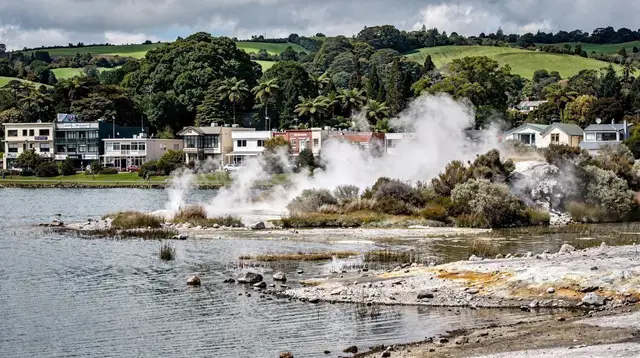
From Ōhinemutu, it’s a short walk to Kuirau Park, a free public geothermal park in the middle of town — steaming ground, bubbling mud pools, and a foot-bath area fed by hot spring water, all with no entry fee and no gate. It’s a smaller, tamer taste of the geothermal features that the paid parks charge for, and it’s worth understanding why the whole town smells the way it does before going further: see why Rotorua smells of sulphur for the short version (hydrogen sulphide gas, not a design flaw).
In the afternoon, walk the Lake Rotorua lakefront past the Government Gardens frontage — the gardens themselves and the striking black-and-white Bath House building are free to view from outside, even though the Bath House has been closed for seismic strengthening. The lakefront path is flat, free, and gives a clear look at the lake that sits inside this whole volcanic system. If time allows, a short local bus ride reaches Hamurana Springs on the north shore, whose short forest walk to a spring-fed pool costs nothing to enter. Finish the day with a self-catered dinner; Rotorua’s supermarkets keep this kind of day close to the free end of the daily budget.
Day 2 — The One Splurge: A Guided Geothermal Park
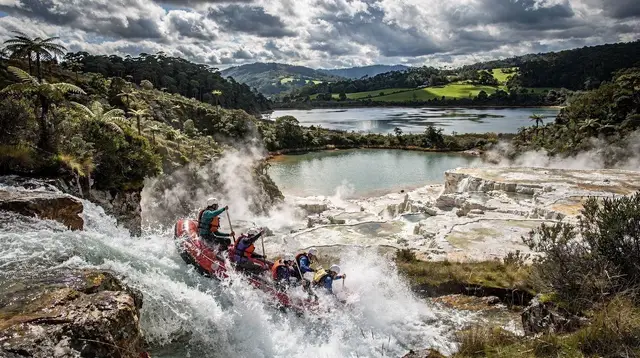
This is the day the budget gets spent. Trying to stretch a tight budget across two or three paid geothermal parks usually means rushing all of them and enjoying none properly — the better trade is one park, seen without rushing. Wai-O-Tapu, about 27 kilometres south of town, is the strongest single choice for colour: the Champagne Pool, the Devil’s Bath, and the Lady Knox Geyser, which is set off each morning using a surfactant rather than erupting on its own schedule. A half-day tour with transfer included removes the need for a rental car entirely, which matters for a car-free itinerary:
a half-day tour to Wai-O-Tapu with transfer from RotoruaFor context on how Wai-O-Tapu compares with the other paid parks and why this plan settles on one rather than several, see which geothermal park should you choose and the dedicated Wai-O-Tapu visiting guide. Travellers who would rather keep the splurge closer to town, with a shorter outing and Māori cultural context built in, can look at a compact afternoon option instead:
an eco thermal afternoon tour that pairs geothermal walking with cultural contextEither choice keeps the day’s spend to the one line in the budget table above. Back in town by evening, a bus or a short taxi ride covers the return leg cheaply; see getting around Rotorua without a car for the practical detail on fares and routes.
Day 3 — The Redwoods and Free Hot Pools
The last day returns to no-cost ground. The Redwoods — Whakarewarewa Forest has a network of ground-level walking trails through Californian redwoods planted in 1901, and the trails themselves are free to walk — only the elevated canopy walkway and the mountain bike trail network carry a fee, and both can be skipped without losing the forest experience. An hour or two among trees this size, with no geothermal steam and no admission gate, is a useful contrast to the previous two days. A full list of no-cost walking routes across the wider area, including alternatives to the Redwoods, is at free walking tracks in Rotorua.
In the afternoon, head to one of the free river-fed hot pools outside town rather than a paid spa. These are simpler than the landscaped commercial pools — no changing rooms, no food service, and conditions that depend on recent rain and river flow — but the water comes from the same geothermal system that feeds the paid options, at no cost. Full detail on locations, access, and what to expect is in free hot springs around Rotorua; for a comparison against the region’s paid hot pools, see the Rotorua hot pools guide.
Travellers with an extra half-day, or who are willing to trade the Redwoods for a short trip out to Te Wairoa, can also consider a lower-cost look at the region’s volcanic history:
a visit to the Buried Village of Te Wairoa, destroyed in the 1886 Tarawera eruptionThat stop sits outside the strict under-300 total above if added on top of the Day 2 spend, so treat it as a substitute for the Day 2 tour rather than an addition, if the budget line needs to hold.
Making the Numbers Work
A few adjustments keep this plan flexible without breaking the budget. Staying in a hostel or holiday park rather than a hotel is what makes the accommodation side of a trip like this realistic in the first place — accommodation costs sit outside the activity total above, but they’re the largest line in any real budget, and Rotorua holiday parks and camping covers the lower-cost options directly. Cooking rather than eating out for most meals is the other lever: supermarkets in central Rotorua make self-catering straightforward, and it’s worth knowing upfront that no restaurant anywhere in the country is allowed to sell trout, so a budget-minded food plan isn’t missing out on a dish that was never on the menu regardless of spend.
For travellers weighing whether three days is even the right length, see how many days in Rotorua; for a version of this same loop with a slightly larger budget and one extra paid stop, the standard 3-day Rotorua itinerary is the natural next step up.
Budget Rotorua Itinerary: Frequently Asked Questions
Can you really visit Rotorua for under 300 NZD in activities over three days?
Yes, if the plan is built around free sites first. Kuirau Park, Ōhinemutu, the Government Gardens frontage, the Lake Rotorua lakefront, and the ground-level Redwoods trails cost nothing to walk through. That leaves the budget for one paid geothermal park entry and food.
What is the one thing worth paying for on a Rotorua budget trip?
A single geothermal park with colour features you cannot see for free, such as Wai-O-Tapu or Waimangu. Trying to see two or three paid parks on a tight budget usually means rushing all of them; one park seen properly is the better trade.
Are Rotorua’s free hot pools as good as the paid spas?
They are a different experience, not a lesser one. The paid spas add changing rooms, food service, and landscaped pools; the free river-fed pools are simpler and weather-dependent, but the water itself comes from the same geothermal system.
Do you need a car for this budget itinerary?
No. Every stop in this plan — Ōhinemutu, Kuirau Park, the Government Gardens, the Redwoods, the lakefront — sits within walking distance of central Rotorua or a short local bus ride. The one paid tour day is usually run with pickup included.
Is Rotorua safe to walk around on foot with a smaller budget and less flexibility?
The central area covered in this itinerary is walkable and well used by both residents and visitors during the day. Standard city-travel caution applies after dark, as it would in any New Zealand town of this size.
What food costs should a budget traveller plan for in Rotorua?
Supermarkets and food courts keep daily food costs well below restaurant prices. One point worth knowing: no restaurant in New Zealand is allowed to sell trout, so a hāngī or a café meal is the realistic budget food experience rather than a fish dinner.
Does rain ruin a budget Rotorua itinerary?
Rotorua gets rain year-round, and geothermal parks are often considered better in the rain, since the steam is more visible against damp ground and cooler air. None of the free sites in this plan require sunshine to be worthwhile.
tours.3 days
Verified deep-linked GetYourGuide tours. Book through these links and we earn a small commission at no cost to you.
Photos show the destination, not the operator's own images.