Rotorua Food and Drink: Eat Streat, Hāngī, and Trout
What's distinctive about eating and drinking in Rotorua?
Most casual dining concentrates on Eat Streat, a covered strip of restaurants in the city centre, alongside a handful of local breweries and cafés. The signature dish is hāngī, food cooked in an earth oven that in Rotorua is often steamed using natural geothermal heat rather than buried coals. Lake trout is the one local specialty no restaurant is allowed to sell, since New Zealand law bans its commercial sale.
Rotorua’s food scene isn’t built around destination restaurants. It’s built around one covered strip in the city centre, a handful of breweries, a geothermal cooking method found almost nowhere else, and a fish that you can catch by the thousand in the surrounding lakes but never once find on a menu. That’s the honest shape of eating and drinking here, and it’s worth understanding before you go looking for something this region doesn’t really offer.
The city’s default: Eat Streat
Eat Streat is the covered, pedestrianised block of restaurants and bars in central Rotorua, running roughly along Tutanekai Street toward the Government Gardens. It functions less like a single venue and more like a row of options you can walk past and compare before committing — pizza, Asian fusion, steakhouse, café-bar — which makes it the practical answer for anyone who hasn’t booked ahead. It’s covered against Rotorua’s frequent rain, which matters more here than in most towns, given how often it falls.
It isn’t the only place to eat, but it is the concentration point. Outside Eat Streat, restaurants in Rotorua are more spread out — along the lakefront, around Ōhinemutu, and scattered through the suburbs — and options thin out earlier in the evening than they do on the main strip. If you’re staying centrally and don’t want to plan, Eat Streat is where a night out usually starts by default rather than by research.
Breweries and pubs
Rotorua has a small, established brewing scene rather than a sprawling one: a few taprooms and brewpubs in and around the city centre, generally pouring New Zealand-style pale ales and lagers, some brewed with local hops, alongside pub-style food. It’s not a beer-tourism destination the way some other New Zealand towns are, but there’s enough to make an evening of it, and taprooms are a reasonable alternative to Eat Streat if you’d rather sit somewhere quieter with a pint than choose between six restaurant frontages.
Bars along and near Eat Streat cover the more standard night-out territory — cocktails, wine lists, sports on the screens — and most kitchens keep serving reasonably late by New Zealand standards, though hours vary by night and by season, so it’s worth checking directly with a venue rather than assuming.
Hāngī: earth-oven cooking, with a Rotorua twist
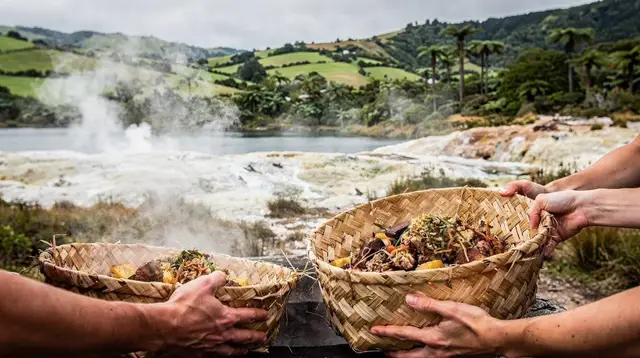
Hāngī is a traditional Māori method of cooking meat and vegetables slowly, using heat trapped underground — usually heated stones in a pit, covered and left to steam for several hours. It produces a smoky, tender result quite different from grilling or roasting, and it’s the dish most associated with a Māori cultural evening anywhere in New Zealand.
What’s specific to Rotorua is the ground itself. Because the city sits inside an active geothermal field, some hāngī here is cooked using natural steam vents rather than a buried pit of heated stones — steam boxes fed directly by the earth’s own heat. It’s the same principle taken a step further: instead of manufacturing heat with fire and stone, you’re using heat the ground is already producing. This is part of why Rotorua smells the way it does and why the volcanic ground here does more than sit under the scenery — it’s put to use.
The most reliable way to try a genuine hāngī is through one of the Te Arawa-run cultural evenings, most of which pair the meal with a performance and an explanation of what’s happening and why. The Te Puia cultural tour is one of the more accessible ways to combine that meal with a guided look at the geothermal valley and the national arts and crafts institute in the same visit, and it’s worth reading how it compares to Whakarewarewa Village before choosing between the two. If you’re arriving from further afield, a combined itinerary such as the Wai-O-Tapu and Te Puia day tour with haka folds the meal and performance into a fuller day rather than a standalone evening.
For background on what a hāngī actually involves before you sit down to one, see the dedicated guide to hāngī and where to eat one, and for the performance itself, what a haka means is worth reading beforehand so it doesn’t read as pure spectacle.
A note on etiquette: these evenings are hosted experiences on living marae or cultural grounds, not theme-park shows, and a little preparation goes a long way. The guide to Māori cultural etiquette in Rotorua covers what’s expected of visitors, and the wider Te Arawa history of Rotorua gives context for why food, performance, and place are tied together here rather than packaged separately.
Cafés, Māori-owned kai, and everyday eating
Away from the evening cultural circuit, daytime eating in Rotorua looks much like the rest of provincial New Zealand: café-style breakfasts and lunches, bakeries, and a growing number of Māori-owned cafés and food stalls serving kai — a general term for food that, in this context, often means dishes with a Māori inflection: fry bread, boil-up, or a version of hāngī sold by the plate rather than as part of an evening package. These tend to cluster near Ōhinemutu and around the lakefront rather than on Eat Streat itself.
Self-catering is a reasonable option too, particularly if you’re staying at one of the holiday parks around Rotorua with kitchen access. Supermarkets in town are ordinary New Zealand supermarkets — nothing Rotorua-specific about the shopping beyond the fact that, whatever else is in the chiller cabinet, it will not include trout.
The trout you can’t buy — and how to eat it anyway
This is the detail that catches most visitors off guard. Lake Rotorua, Lake Rotoiti, and Lake Taupō support some of the best-known trout fishing in the Southern Hemisphere, and yet no restaurant, fishmonger, or supermarket in New Zealand is allowed to sell trout. It’s a deliberate policy choice, not an oversight: trout were introduced for recreational fishing, and keeping them out of commercial sale is meant to protect that fishery rather than turn it into a supply chain. The result is a genuinely unusual situation — a region famous for a fish that literally cannot be bought.
So how do people actually eat it? Almost always one of two ways. First, by fishing for it yourself and having it cooked — plenty of guides and a few lodges around Rotorua and Taupō will clean, prepare, and cook your legally caught trout the same day, sometimes as a hāngī-style preparation, sometimes simply grilled or smoked. Second, by fishing with a guide who does the catching (or most of it) and still hands you a meal at the end of the trip rather than a fish to take home raw. Either way, the trout on your plate has to trace back to a rod, a licence, and a catch — never a supplier.
If trout fishing is the reason you’re in the region at all, the dedicated guide to trout fishing around Rotorua and Taupō covers licences, seasons, and where the fishing itself is best, and the wider look at why the trout that cannot be sold explains the legal history behind the rule in more depth than fits here.
Budget, mid-range, and splurge
Rotorua’s food costs sit within normal New Zealand ranges — there’s no premium specific to the town beyond what applies to tourist-facing venues generally.
| Style | What it looks like | Rough range per person |
|---|---|---|
| Budget | Takeaways, bakeries, self-catering, casual cafés | Fits within a routine budget day — see Rotorua on a budget |
| Mid-range | Sit-down dinner on Eat Streat, a brewpub meal | Comfortable within a typical mid-range daily spend |
| Evening cultural package | Hāngī meal plus performance and often transport | Priced as an experience rather than a meal, reflecting the added guiding and hosting |
These are ranges, not quotes — menus and package inclusions change, so check current pricing with the venue or operator directly rather than budgeting off a number from any guide, including this one. For a fuller sense of how food fits into an overall daily spend, the Rotorua on a budget guide breaks down costs across a full day, and free things to do in Rotorua is a useful pairing if you’re putting more of the budget toward a hāngī evening and less toward everything else.
Fitting food around the rest of the day
Meal planning in Rotorua tends to fall into place around whatever else is on the itinerary rather than the other way round. A geothermal morning followed by an evening hāngī and performance is a common shape for a first day — the eco thermal afternoon tour is one way to fill the daylight half of that pairing. Cruise passengers based in Tauranga for the day sometimes fit a cultural meal into a single shore excursion rather than a separate evening — the Rotorua shore excursion with Te Puia is built around exactly that constraint.
If food is one part of a longer stay rather than a single evening, how many days in Rotorua is worth reading alongside this guide when you’re sketching the rest of the trip, and Rotorua with Kids: The Family Itinerary That Actually Works covers how well a hāngī evening tends to suit younger travellers specifically.
None of this requires much advance planning if you’re staying centrally — Eat Streat covers casual dining without a booking, breweries fill in a quieter evening, and the cultural hāngī evenings are generally bookable a day or two ahead rather than weeks out. The one thing worth deciding early is whether trout fishing is part of the trip, since that’s the one Rotorua food experience that has to be arranged rather than simply walked into.
Rotorua food and drink FAQ
What is Eat Streat in Rotorua?
Eat Streat is a covered, pedestrianised strip in central Rotorua lined with restaurants and bars, roughly between Tutanekai Street and the Government Gardens. It’s the default place to wander when you haven’t booked anywhere, since you can compare several menus side by side without moving the car.
Can I actually eat trout caught in Rotorua’s lakes?
Yes, but only if you or someone in your group caught it, or a guide caught it for you. Selling wild trout is illegal in New Zealand, so no restaurant, market, or supermarket carries it. Some fishing guides and lodges will cook your catch for you the same day.
Where can I try a real hāngī in Rotorua?
The evening cultural experiences at Te Puia, Whakarewarewa Village-linked venues, and other Te Arawa-run operators typically include a hāngī meal alongside a performance. Several use geothermal steam rather than a buried-coal pit, which is specific to Rotorua’s volcanic ground.
Are there good breweries in Rotorua?
Rotorua has a small but established brewing scene, mostly taprooms and brewpubs in and around the city centre rather than large production breweries. Expect New Zealand-style pale ales and lagers, often using local hops, served alongside pub food.
Is Rotorua expensive for food?
Rotorua sits in line with the rest of New Zealand: a takeaway meal or café lunch is inexpensive, a casual restaurant dinner is moderate, and a cultural-evening hāngī package costs more because it includes a performance and transport. Prices shown already include GST, and tipping isn’t expected.
Do any restaurants in Rotorua serve trout?
No. It is illegal to sell wild-caught trout commercially anywhere in New Zealand, so it never appears on a menu as a purchasable dish, even in a region built around trout fishing. The only route to eating it is catching your own or having a guide catch it for you.
What’s the best area to eat in Rotorua at night?
Eat Streat and the surrounding blocks of central Rotorua hold the highest concentration of restaurants and bars open in the evening. Ōhinemutu and the lakefront have a few options too, but they thin out earlier.
Is tipping expected at restaurants in Rotorua?
No. Tipping isn’t a New Zealand custom, and staff don’t expect it. The price on the menu is the price you pay, since the 15% GST is already built in.
Food & drink tours in Rotorua on GetYourGuide
Verified deep-linked GetYourGuide tours. Book through these links and we earn a small commission at no cost to you.
Photos show the destination, not the operator's own images.