Rotorua vs Queenstown: North Island or South?
Should I visit Rotorua or Queenstown?
They are not substitutes. Rotorua is a geothermal and Māori-culture hub on the North Island; Queenstown is an alpine adventure base on the South Island, near glaciers and fjords. Most itineraries longer than about ten days include both rather than choosing one.
Two adventure capitals, one long country
New Zealand markets itself, fairly consistently, as an adventure destination. But the country is split across two main islands, and its two best-known adventure bases sit at opposite ends of it. Rotorua, on the North Island, and Queenstown, on the South Island, are roughly 1,400km apart as the crow flies — further still by any actual route, since there is no bridge or tunnel across the Cook Strait separating the two islands. A traveller planning a short trip often assumes these two names are interchangeable shorthand for “the exciting part of New Zealand.” They are not. They sit on different geology, in different climates, and they specialise in different things.
This page is not a verdict on which one wins. It is a working comparison: what each place actually offers, where they overlap, where they don’t, and how to decide whether your itinerary needs one of them or both.
What Rotorua is
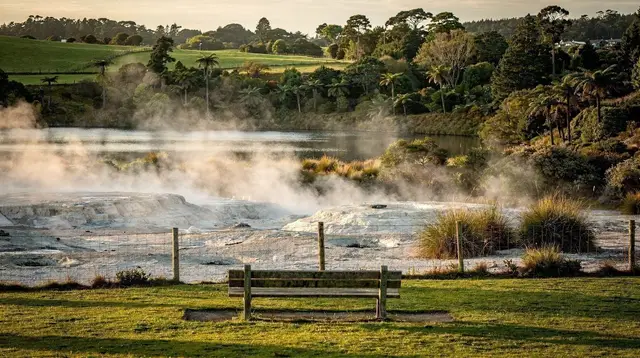
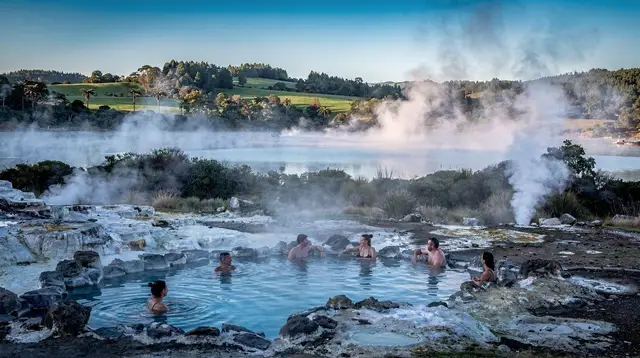
Rotorua is a city of around 60,000 people built directly on top of an active geothermal field, part of the roughly 250km-long Taupō Volcanic Zone that runs from Whakaari/White Island in the north down to Mount Ruapehu in the south. That is why steam rises from footpaths and drains around the city, why there’s a faint smell of sulphur in parts of town, and why the area has geysers, mud pools and thermal springs within a short drive of the centre. It is also the traditional and present-day heart of Te Arawa, and Māori culture here is lived rather than staged for visitors — Ōhinemutu, a residential village inside the city, is a working example of that.
Rotorua’s identifiable strengths:
- Geothermal landscapes — Wai-O-Tapu, Waimangu Volcanic Valley, and Hell’s Gate each show a different side of an active volcanic field: coloured pools, craters, and the only geothermal system in the world with a documented birth date.
- Māori cultural experiences — Te Puia and the living village of Whakarewarewa sit side by side, with the reliable Pōhutu geyser between them. See our comparison of Te Puia and Whakarewarewa Village for the differences.
- Adventure activities built around forest and water rather than mountains: mountain biking through The Redwoods, whitewater rafting on the Kaituna past the world’s highest commercially rafted waterfall, and ziplining through native canopy.
- A cluster of lakes — Rotorua, Rotoiti, Tarawera, and the striking side-by-side Blue and Green Lakes — used for kayaking, cruising, and swimming in summer.
What Rotorua does not have: mountains with permanent snow, glaciers, or fjords. It is not built for alpine scenery, and it should not be marketed or expected as one.
What Queenstown is
Queenstown sits on the South Island, on the edge of Lake Wakatipu, in a landscape shaped by an entirely different geological history — the Southern Alps rather than a volcanic plateau. This is the part of New Zealand where the glaciers, fjords and permanently snow-capped peaks that the North Island simply does not have come into the picture: Milford Sound, the Southern Alps, Aoraki/Mount Cook and Franz Josef are all South Island landmarks, hours from Queenstown but part of the same alpine identity. Queenstown itself has built its reputation as the country’s adventure-sports base, with ski fields close by for winter visitors and a wider array of adrenaline activities than Rotorua offers.
Where the two overlap: both are compact, walkable towns built around a lake, both pull in visitors year-round rather than in one narrow season, and both function as a hub for day trips into more dramatic surrounding landscape rather than being the whole show themselves.
Where they diverge is the landscape underneath them. Rotorua is flat-to-rolling and geothermal; Queenstown is alpine and glacial. That single difference explains almost everything else on this page.
Side-by-side: what each does better
| Category | Rotorua does better | Queenstown does better |
|---|---|---|
| Geothermal sights | Geysers, mud pools, hot springs, coloured crater lakes | Not applicable — no active geothermal field |
| Māori culture | Living villages, marae visits, hāngī, haka performed by Te Arawa | Limited by comparison; not a Māori cultural centre |
| Mountain and alpine scenery | None — no permanent snow, no glaciers | Southern Alps, glaciers, snow-capped peaks nearby |
| Fjords | None | Milford Sound and Fiordland within reach |
| Whitewater rafting | Kaituna River, several grades, close to town | Also available, on different rivers |
| Mountain biking | The Redwoods, internationally rated trail network | Well-regarded trails as well, alpine terrain |
| Winter skiing | None in Rotorua itself; Ruapehu is a separate drive | Ski fields close to town in winter |
| Lakes for kayaking/cruising | Rotorua, Rotoiti, Tarawera and more | Lake Wakatipu and nearby lakes |
| Forest walks | Redwoods, Whirinaki, native bush close to the city | Alpine and lakeside walking tracks |
Neither column is longer because one place is “better” overall — it’s longer wherever a given category simply doesn’t exist on the other side.
Climate and when to go
Both towns sit in the southern hemisphere, so the seasons are the reverse of the northern hemisphere’s: summer runs December to February, winter June to August. Rotorua’s climate is temperate and geothermal-influenced — summer maximums around 23–24°C, winter maximums around 12–13°C, rain spread across roughly 140 days a year with no true dry season. Cold air actually makes the geothermal areas more visually dramatic, since the steam shows up more clearly.
Queenstown, further south and at higher elevation near the Alps, runs noticeably colder in winter, which is exactly why it doubles as a ski town in that season — something Rotorua cannot offer on its own doorstep. Our guide to Rotorua’s weather month by month and to visiting in winter cover the North Island side of that split in detail. If your trip is built around snow sports, that pulls the itinerary toward Queenstown’s season; if it’s built around geothermal sightseeing and Māori cultural experiences, Rotorua works in any month, since there’s no closed season there.
Getting between the two
There is no direct road between Rotorua and Queenstown, because they are on different islands. Realistic options are:
- Fly, usually connecting through Auckland or Christchurch, since direct routes are limited and change over time — check current schedules with an airline rather than assuming a direct flight exists.
- Drive and ferry, covering the North Island by road down to Wellington (around 6 hours from Rotorua with no stops), crossing the Cook Strait by ferry, then continuing by road through the South Island to Queenstown — a multi-day undertaking, not a day’s drive.
Most visitors on a standard two-to-three-week trip fly this leg rather than drive it, saving the road time for shorter, scenic stretches on each island instead. Our page on driving in New Zealand for visitors covers the basics of left-hand driving and road conditions if you are self-driving any part of the journey. For the North Island portion specifically, see getting to Rotorua and the Rotorua airport guide.
Costs: roughly comparable, not identical
Both towns operate within New Zealand’s general cost bands: broadly speaking, a budget traveller might expect to spend somewhere around 150 NZD a day, a mid-range traveller around 350 NZD a day, and a higher-end trip 700 NZD a day or more, per person — figures that flex with season, exchange rate and how many paid activities you stack into a day. Neither town is reliably cheaper than the other across the board; specific accommodation and tour prices shift too often to state as fact here, so treat any number you see elsewhere as a snapshot, not a guarantee. Note that in both places, the price you’re shown already includes New Zealand’s 15% GST, and tipping is not expected. Our Rotorua on a budget guide breaks down the North Island side of that cost picture in more detail.
So which one goes in the itinerary?
For a short trip — under about ten days — most visitors have to choose a primary base, because flying back and forth between islands eats into limited time. In that case, the choice comes down to what you actually want from the trip:
- Choose Rotorua if geothermal landscapes, Māori cultural experiences, forest mountain biking, or a Hobbiton day trip from a single base matter most.
- Choose Queenstown if alpine scenery, glaciers, fjords, or ski season are the priority.
For a longer trip — two weeks or more, which is common for visitors flying long-haul to reach New Zealand in the first place — there’s rarely a real trade-off, since both fit comfortably into a North Island plus South Island itinerary. A common shape is several days around Rotorua and the wider Bay of Plenty and Waikato area, then a flight south to build a separate loop around Queenstown, Fiordland and the Alps.
If you’re specifically weighing up how much time to allocate on the Rotorua side of that split, our guides on how many days in Rotorua and the 3-day Rotorua adventure itinerary are a reasonable starting point, alongside an honest verdict on Rotorua and whether Rotorua feels too touristy for independent travellers.
What to actually book in each place
Because the two towns specialise differently, the activities worth booking differ too. In Rotorua, that generally means geothermal parks, Māori cultural visits, and forest-and-water adventure rather than alpine sports. A geothermal park visit paired with a cultural stop covers a lot of ground in a single outing — an afternoon geothermal tour around Rotorua’s thermal valleys is one way to do that without organising transport yourself.
For travellers who want the adrenaline side of Rotorua without heading south to Queenstown, combination tours covering ziplining and rafting on the same day cover a fair share of that ground: see our Rotorua adventure activities ranked and comparison of Rotorua’s ziplines for how they stack up, or book a combined zipline and whitewater rafting day near Rotorua directly. Travellers who prefer a slower pace, or are travelling with people less keen on rafids and ziplines, might instead look at a scenic horse trek through Rotorua’s countryside as a gentler way to see the landscape between geothermal stops.
None of this substitutes for what Queenstown offers on its side of the country — this page isn’t trying to talk you out of going south. It’s simply pointing out that the two towns are complementary rather than competing, and that planning both into a longer trip, rather than agonising over which one to cut, is usually the more satisfying outcome.
Common mistakes when comparing the two
A few assumptions come up often enough to flag directly:
- Assuming Rotorua has mountains or snow. It doesn’t. Ruapehu, the North Island’s ski mountain, is a separate destination from Rotorua, reachable via Tongariro National Park, not part of the Rotorua geothermal area itself.
- Assuming Queenstown has geothermal activity. It doesn’t; that is specifically a North Island, Taupō Volcanic Zone phenomenon.
- Assuming a rental car makes both reachable in one loop. The islands are separated by open water; a ferry crossing and a long drive are required, or a flight.
- Assuming Hobbiton or Waitomo are near Queenstown. Both are North Island sites, closer to Rotorua than to anywhere on the South Island — see Hobbiton from Rotorua if that’s on your list.
- Treating one as a “better” version of the other. They’re built on different geology and serve different interests; “better” depends entirely on what you’re travelling to see. Our guided tours vs self-drive page covers a related decision — how to move around whichever base you choose — that applies almost identically on either island.
If your trip has room for a whitewater rafting session and a walk through native forest as a single outing while you’re in the Rotorua area, a guided walk through Whirinaki Forest with a local guide is a lower-key way to see native bush that doesn’t require the adrenaline commitment of rafting or ziplining, and pairs well with a shorter Rotorua stay before flying south.
Choosing between Rotorua and Queenstown: FAQ
Is Rotorua or Queenstown better for a first trip to New Zealand?
Neither replaces the other. A first trip of two weeks or more typically covers both islands, with Rotorua as the North Island’s geothermal and cultural stop and Queenstown as the South Island’s alpine and adventure stop.
How far apart are Rotorua and Queenstown?
Around 1,400km apart in a straight line, on two different islands separated by the Cook Strait. There is no direct road route; getting between them means flying, or driving plus a ferry crossing.
Can I fly directly between Rotorua and Queenstown?
Direct flights are limited and change over time, so most travellers connect through Auckland or Christchurch. Check current routes with an airline or a booking search rather than assuming a direct service exists.
Does Rotorua have mountains and glaciers like Queenstown?
No. Rotorua sits in the Taupō Volcanic Zone, known for geothermal activity, not snow-capped peaks. Glaciers, fjords and the Southern Alps are all on the South Island, near Queenstown, not around Rotorua.
Is Queenstown more expensive than Rotorua?
Both are well-established tourist bases within New Zealand’s typical cost ranges, roughly 150 NZD a day for a budget traveller up to 700 NZD or more for a high-end stay. Specific price differences shift with season and exchange rate, so treat any fixed figure as a guide only.
Which is better for bungy jumping and adrenaline sports?
Queenstown and nearby Taupō are the country’s established adrenaline hubs for activities like bungy jumping. Rotorua’s adventure scene leans toward whitewater rafting, ziplining, mountain biking and luge rather than bungy, since there is no commercial bungy operation in Rotorua itself.
How many days should I spend in each?
For Rotorua, two to four days is enough to cover geothermal parks and Māori cultural experiences without rushing. Queenstown’s surrounding attractions, including day trips toward fjords and glaciers, tend to fill a similar or longer window depending on how far travellers range from the town itself.
Do I need a car to enjoy either destination?
A car (or organised tours) helps in both, since the best sights sit outside the town centres. In Rotorua, geothermal parks and lakes are a short drive out; around Queenstown, fjords, glaciers and alpine passes are a longer drive still worth planning ahead for.
Popular Rotorua experiences on GetYourGuide
Verified deep-linked GetYourGuide tours. Book through these links and we earn a small commission at no cost to you.
Photos show the destination, not the operator's own images.