4 Days in Rotorua: Geothermal, Culture and Hobbiton
Four days, and one decision you can leave until day three
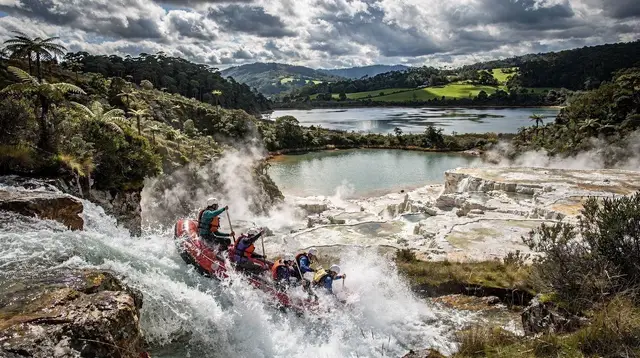
Three days in Rotorua covers the geothermal core and a Hobbiton run comfortably. A fourth day is where this itinerary earns its place, because it doesn’t hand you a fixed answer — it hands you a fork. Head northwest and you’re underground in Waitomo, drifting through limestone passages lit by a bioluminescent larva. Head south and you’re at Huka Falls, then on the shore of the largest lake in the country. Neither is better in the abstract; they’re different distances, different times, different days. Below, both are costed and timed so the choice is a five-minute decision on the morning of day three, not a research project before you land.
This route assumes a rental car. If you’re relying on shuttles and tours instead, see getting around Rotorua without a car before you commit to the driving version below.
Day 1: Rotorua orientation and geothermal grounding
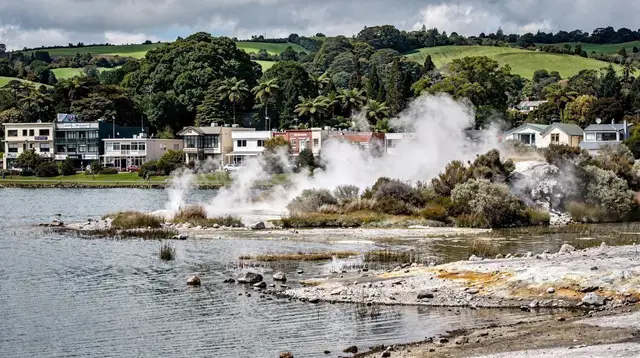
Land in Rotorua and spend the first afternoon getting used to the fact that the ground itself is doing something. This is a caldera city sitting inside the Taupō Volcanic Zone, and the steam vents on ordinary streets, the sulphur smell, and the boiling pockets in public parks aren’t staged for visitors — read why Rotorua smells of sulphur if the hydrogen sulphide catches you off guard, because it doesn’t fade by day two, it just stops registering.
Walk or drive to Ōhinemutu, the Ngāti Whakaue village built directly on the lakefront in the middle of town, where people still live around the marae and St Faith’s Church has its carved Christ figure etched into a window facing the water. This isn’t a reconstruction — it’s a working village, and the Māori cultural etiquette guide is worth five minutes before you go: photography rules and behaviour around the marae are specific, not optional.
In the afternoon or evening, choose one cultural experience to anchor the trip. Rotorua runs several, from Te Puia’s evening programme to standalone hāngī-and-concert venues, and they’re genuinely different in format and focus — the comparison in Māori cultural experiences compared is more useful than picking on brand recognition alone. If a hāngī — meal cooked in an earth oven, often steamed with geothermal heat here rather than buried and fired — is part of the evening, hāngī: what it is and where to eat one explains what you’re actually eating and why it tastes different from a barbecue.
Sleep in Rotorua; every day trip in this itinerary radiates out from here.
Day 2: Wai-O-Tapu, Te Puia and the geothermal valleys
Day two is the geothermal day proper. Leave early for Wai-O-Tapu, about 27 km south of town on SH5 — the Champagne Pool and the Devil’s Bath are the reason most people come, but the timing matters: the Lady Knox geyser is triggered daily at 10:15am with a surfactant, and it’s worth building the morning around that fixed slot rather than treating it as optional. The full walkthrough in Wai-O-Tapu visiting guide covers the loop order.
a Wai-O-Tapu entry ticket booked ahead avoids queuing at the gate on a morning when you’re racing the geyser schedule.
With Wai-O-Tapu done by early afternoon, you have two directions to fill the rest of day two, and either works depending on what you skipped on day one: Te Puia, the national Māori arts and crafts institute, where Pōhutu — the most reliable geyser in the southern hemisphere — erupts once or twice an hour up to around 30 metres; or Waimangu Volcanic Valley, the only geothermal system on earth with a known birth date, created by the Tarawera eruption of 10 June 1886, with Frying Pan Lake and Inferno Crater as its centrepieces. If you want both Wai-O-Tapu and Te Puia without doubling back on your own driving, a combined day tour exists:
a guided day covering Wai-O-Tapu, Waimangu and Te Puia together — useful if you’d rather not self-drive between three separate gates in one day. For a broader sense of how these parks differ before you decide, which geothermal park to choose lays out the trade-offs directly.
End the day back in Rotorua. If your legs and your schedule allow it, Whakarewarewa Village — the still-inhabited thermal village of Tūhourangi Ngāti Wāhiao, where people cook by geothermal steam today — pairs naturally with Te Puia since they share the same valley.
Day 3: Hobbiton Movie Set
Day three leaves the geothermal zone entirely. Hobbiton Movie Set sits on the Alexander family farm near Matamata, roughly 50 minutes from Rotorua by road, and it’s a permanent set — 44 hobbit-hole facades and the Green Dragon, built in durable materials after the 2011 rebuild rather than struck down after filming. Access is guided only; you don’t wander the set independently.
a Hobbiton tour with return transport from Rotorua removes the need to navigate Matamata’s booking gate yourself and to time a return drive. If you’d rather drive yourself and just book entry, the guide on getting from Rotorua to Hobbiton covers both approaches, and the complete Hobbiton guide covers what the walking tour actually includes.
Budget the better part of a day for this even though the drive is short: the tour itself runs a couple of hours, and Matamata isn’t a town most people linger in afterward, so most visitors are back in Rotorua for a late dinner. This is also, worth noting up front, the only day of the four spent outside the geothermal zone and away from Te Arawa territory — the shift in landscape from steaming valleys to rolling green farmland is deliberate contrast, not an accident of routing.
Return to Rotorua for the night. Day four’s fork starts from here.
Day 4: the fork — Waitomo’s caves or Taupō’s lake
This is the day this itinerary is built around. Both options are full day trips from Rotorua and back; neither can be combined with the other in a single day without turning it into a driving marathon. Here’s what each actually costs in time and distance.
Option A: Waitomo glowworm caves
Waitomo is roughly 150 km from Rotorua by road — figure close to 2 hours each way, so around 4 hours of driving if you self-drive both legs. The draw is underground: limestone caves lit by Arachnocampa luminosa, a carnivorous glowworm larva that hangs sticky threads to fish for insects in total darkness, turning cave ceilings into something that looks like a still night sky. The main boat-through cave, plus Ruakuri and Aranui alongside it, are covered in Waitomo glowworm caves: which tour, and the biology itself is explained in what are glowworms if the “why do they glow” question is what’s pulling you there.
a small-group tour combining Hobbiton and Waitomo caves is worth flagging here even though it departs from Hamilton rather than Rotorua — if you’re flexible on where day three and four start, it collapses two of this itinerary’s stops into one outing. For travellers who’ve already done Hobbiton separately, a private door-to-door option also exists:
a private day trip covering Hobbiton and Waitomo’s glowworm cave, which trades cost for not having to drive either leg yourself.
Given the round-trip driving load, this option eats most of a day even before you factor in cave time. A budget traveller doing this as a self-driven day trip with one cave ticket sits close to the lower end of the routard band (around 150 NZD/day) once fuel is factored in; add a guided small-group tour instead of self-driving and a mid-range day (around 350 NZD) is realistic.
Option B: Lake Taupō and Huka Falls
Taupō is about 80 km from Rotorua — roughly an hour each way, so around 2 hours of driving round trip, less than half the Waitomo option. On arrival, Huka Falls is the immediate stop: the Waikato River is forced through a gorge only around 15 metres wide, and the volume of water moving through that narrow channel is the whole spectacle. From there, Lake Taupō itself — at 616 km² the country’s largest lake, sitting in the crater of a super-eruption — opens up boating, walking and swimming options that Waitomo’s underground itinerary simply doesn’t offer.
a full-day tour linking Huka Falls, hot springs and Hobbiton is worth knowing about specifically because it threads Hobbiton and Taupō into a single day for anyone willing to restructure days three and four rather than keep them separate. For something faster and higher, a helicopter option covers the same falls from the air alongside Māori rock carvings on the lake:
a helicopter flight over Huka Falls and Māori rock carvings compresses what would otherwise need a boat trip into carvings access into a short flight — at real cost, but real time saved.
With roughly half the driving of the Waitomo option, a Taupō day frees up actual time on the ground: a self-driven day covering Huka Falls, a lakeside walk and lunch sits comfortably in the routard-to-mid-range band (150–350 NZD); adding a boat trip to see the Mine Bay rock carvings or a jet-boat run pushes it toward the upper end of mid-range. For the falls-and-jet-boat combination specifically, Huka Falls and Taupō jet boats breaks down what’s on offer once you’re there.
Waitomo or Taupō — the numbers side by side
| Waitomo | Taupō | |
|---|---|---|
| Distance from Rotorua | ~150 km one way | ~80 km one way |
| Drive time, round trip | ~4 hours | ~2 hours |
| Core draw | Underground glowworm caves | Waterfall, lake, rock carvings |
| Free time left in the day | Limited | Generous |
| Typical day budget, self-driven | Routard to mid-range | Routard to mid-range, lower end |
| Better fit if | The caves are the whole reason for the trip | You want the lake as well as one stop |
If you genuinely can’t choose, the honest answer is that Taupō is the lower-commitment pick because the drive costs you half as much time — but Waitomo is the one people regret skipping more often, because there’s nothing else like it anywhere else on this itinerary. For a written comparison built the same way, see Rotorua to Waitomo day trip and Rotorua to Taupō day trip.
Driving this route
All four days assume a rental car, and the distances above are for reference — see driving in New Zealand for visitors before day one if this is your first time driving on the left. Fuel and a full day of driving on day four (whichever option you pick) are the main added costs against the mid-range band used throughout this itinerary; neither day involves technical roads, but both are long enough that starting early matters more than starting fast.
Where to stay
Base in Rotorua for all four nights — nothing in this itinerary requires relocating, since even the longest day trip (Waitomo) returns you to the same town each evening. See Rotorua: where to stay for area-by-area guidance if you haven’t booked yet.
Frequently asked questions about this 4-day Rotorua itinerary
Should I book Waitomo or Taupō before I arrive?
Neither needs to be locked in before day one. Decide by the evening of day three, once you know how day one and two actually went — a slower geothermal day might tilt you toward the shorter Taupō drive, while a smoother pace leaves room for Waitomo’s longer round trip.
Can I fit both Waitomo and Taupō into four days?
Not comfortably. Together they’d add roughly 6 hours of driving on top of the rest of the itinerary. A 5-day version of this route, covered in Rotorua 5 days, is the more realistic way to do both.
Is Hobbiton worth a full day if Waitomo or Taupō follows the next morning?
Yes — the tour itself is only a couple of hours, but most visitors are back in Rotorua by early evening either way, so day three isn’t as demanding as day four regardless of which fork you pick.
Do I need a 4WD or special vehicle for any of this?
No. Every road on this itinerary, including the drives to Wai-O-Tapu, Hobbiton, Waitomo and Taupō, is sealed highway suitable for a standard rental car.
What if it rains on the geothermal days?
Wai-O-Tapu, Te Puia and Waimangu are all outdoors but generally better, not worse, in the rain — the steam and colour read more strongly against grey skies. Hobbiton and the Waitomo caves are largely sheltered regardless of weather.
Is this itinerary the same in winter and summer?
The stops don’t change, but daylight does — winter’s shorter days make an early start on day four (whichever direction you choose) more important, since the driving eats a larger share of the available light. See Rotorua weather month by month before fixing dates.
Could I do this itinerary without a car?
Day one and two work fine without one, since Rotorua’s core sites are close together or tour-served. Days three and four are harder without a car — most Hobbiton, Waitomo and Taupō options above already include transport from Rotorua for exactly this reason.
tours.4 days
Verified deep-linked GetYourGuide tours. Book through these links and we earn a small commission at no cost to you.
Photos show the destination, not the operator's own images.