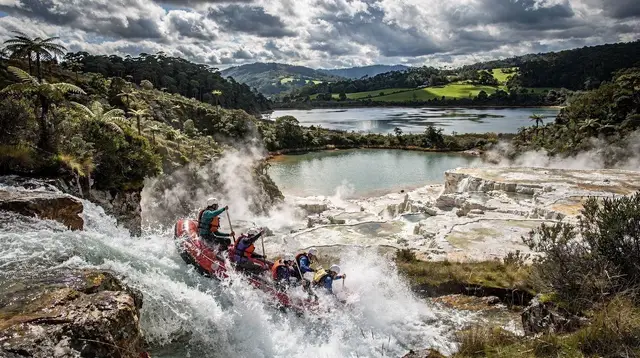
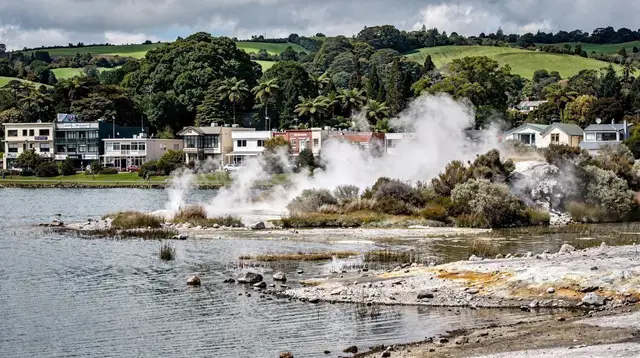
Rotorua in 5 Days: Volcano, Hobbiton, Taupō and the Coast
Five days is enough to get past the geyser-and-photo version of Rotorua and into the wider region around it: the volcano that reshaped the landscape in 1886, the film set outside Matamata, a lake an hour south, and a coastline an hour in the other direction. This itinerary treats Rotorua as a base rather than the entire trip — two days inside the city’s geothermal and cultural sites, then three days that fan out from it. It assumes a rental car; if you’d rather not drive, see driving in New Zealand and getting to Rotorua for the alternatives.
How the five days break down
| Day | Focus | Main stops |
|---|---|---|
| 1 | Rotorua orientation | Ōhinemutu, lakefront, Redwoods forest |
| 2 | Geothermal valley | Whakarewarewa Village, Te Puia, Pōhutu geyser |
| 3 | Volcanic landscapes | Wai-O-Tapu, Mount Tarawera |
| 4 | Film set day trip | Hobbiton Movie Set, Matamata |
| 5 | Choice of direction | Taupō, or Tauranga and Mount Maunganui |
Rain falls roughly 140 days a year here, with no dry season to plan around, and geothermal parks are often better in the rain than a bright sky suggests — the steam reads more clearly. Build in slack rather than a tight schedule; opening hours and track conditions change with weather and maintenance, so check with the operator or the Department of Conservation directly rather than relying on this page for timing.
Day 1: Settling into Rotorua
Start slowly. Rotorua sits directly on a lake and inside a caldera, and the clearest way to feel that is on foot along the lakefront and through Ōhinemutu, the Ngāti Whakaue village inside the city itself — steam vents beside front gardens, communal cooking pools, and St Faith’s Church with its etched-glass Christ looking out over the water. This is a lived-in place, not a reconstruction.
In the afternoon, head to the Redwoods Whakarewarewa Forest, planted with Californian sequoias in 1901 and now one of the region’s mountain-biking hubs, with a canopy walkway running through the treetops by day and lit by night. A flat forest walk works just as well if biking isn’t the plan.
Reserve the evening for a first taste of Te Arawa culture: a hāngī meal and performance is the most common entry point, and it’s worth reading what a hāngī actually is before choosing where to eat one, along with a comparison of Rotorua’s cultural experiences — options range from marae-based evenings to the daytime performances built into Te Puia and Whakarewarewa Village, which this itinerary visits properly tomorrow.
Day 2: Whakarewarewa and Te Puia
Rotorua’s most concentrated geothermal ground sits in one valley shared by two very different places. Whakarewarewa Village is a living community of Tūhourangi Ngāti Wāhiao, where residents still cook using the geothermal steam rising through their own backyards. Te Puia, next door, is the national institute for Māori arts and crafts, with carving and weaving schools open to visitors and its own thermal valley. Between them stands Pōhutu, the most reliable geyser in the Southern Hemisphere, erupting once or twice an hour up to around 30 metres — see when Pōhutu tends to erupt before timing your visit, and Te Puia versus Whakarewarewa Village if choosing between the two rather than doing both.
Given how much ground this covers, most visitors pick one in the morning and treat the other as optional depending on time and interest. Either way, this is also a natural day to slot in a soak — the region’s hot pools range from resort-style spas to free bush pools, covered in the hot pools guide.
Day 3: Wai-O-Tapu and Mount Tarawera
This is the volcano day, and it runs in two very different registers.
Wai-O-Tapu, around 27 kilometres south of Rotorua on State Highway 5, is the region’s most photographed geothermal park: the Champagne Pool’s orange rim, the Devil’s Bath’s acid green, and the Lady Knox geyser, triggered each morning with a surfactant rather than erupting naturally on its own schedule — check current timing with the park directly, since operations can shift. The Wai-O-Tapu visiting guide covers the walking loops in more detail. A combined day tour is the simplest way to see it alongside nearby Waimangu and Te Puia without doubling back on yourself:
a combined Wai-O-Tapu, Waimangu and Te Puia day tour from RotoruaIn the afternoon, turn to Mount Tarawera itself — the mountain that split open on 10 June 1886, killed more than a hundred people, and buried the Pink and White Terraces along with the village now preserved as the Te Wairoa Buried Village. The summit belongs to local iwi and access is guided only, whether on a supported walk or from the air. For an overview of the crater and the wider eruption scar without the walk, a scenic flight covers the same ground in less time:
a scenic flight over Mount Tarawera and the Waimangu ValleyFor those who’d rather be on foot, guided walks up Tarawera run from Rotorua and take most of a day on their own — in that case, this itinerary’s two stops can be split across a morning and the following morning instead of squeezed into one day.
Day 4: Hobbiton and the Waikato
Matamata sits about 50 minutes from Rotorua by road, and Hobbiton Movie Set is the reason to make the drive: 44 hobbit holes built into the Alexander family’s working farm in 2011, ending at the Green Dragon for a drink included in most tickets. The set tour itself runs a couple of hours, guided throughout, so the rest of the day is the drive, the town, and time to spare — read how to get to Hobbiton from Rotorua for the route and timing, and the complete Hobbiton guide for what the tour actually covers.
the Hobbiton Movie Set tour from RotoruaSome operators combine Hobbiton with Waitomo’s glowworm caves in a single long day; it’s possible, but it makes for a genuinely full day on the road rather than a relaxed one, and travellers with more flexibility often prefer to give Waitomo its own separate trip.
Day 5: Taupō or the coast
The fifth day is where this itinerary splits, because Taupō and Tauranga sit roughly an hour from Rotorua in opposite directions — combining both in one day isn’t realistic, so pick based on what draws you more.
South to Taupō: the town sits on the edge of Lake Taupō, New Zealand’s largest lake and itself the crater of a super-eruption. The Huka Falls, where the Waikato River is forced through a gorge roughly 15 metres wide, are close to town and free to see. On the water, the Māori rock carvings at Mine Bay — cut into the cliffs in the late 1970s and only reachable by boat or kayak — are the other highlight:
a kayaking tour to the Māori rock carvings on Lake TaupōNorth to the coast: Tauranga and neighbouring Mount Maunganui offer what the previous four days don’t — open sea and sand. Mauao, the cone at the tip of Mount Maunganui, takes around 45 minutes to the summit or can be circled on its flatter base track in about 3.4 kilometres, and the town itself has a beach-town pace that contrasts with Rotorua’s geothermal ground.
Either option works as a last day before heading on to Auckland or back to Rotorua for a departure the next morning.
Budget for five days
These are rough per-person, per-day guides rather than fixed prices — actual costs depend heavily on accommodation choices and how many paid activities you add:
| Style | Per person, per day | What it typically covers |
|---|---|---|
| Backpacker | around NZD 150 | hostel dorm, self-catering, free or low-cost sites |
| Mid-range | around NZD 350 | private room or motel, a mix of paid tours and free stops |
| Higher-end | around NZD 700 | boutique accommodation, private or guided tours most days |
New Zealand’s 15% GST is already included in every price you see, and tipping isn’t expected — see tipping and costs in New Zealand if that’s unfamiliar. For where to sleep across these five nights, the Rotorua accommodation guide covers the options by area and budget.
FAQ: planning this Rotorua itinerary
Is five days enough to see Rotorua and its surroundings properly?
Five days covers the city’s geothermal and cultural core plus three of the region’s headline day trips — a volcano, a film set and either a lake or a coastline. It won’t stretch to everything (Waitomo and Coromandel are both further out), but it avoids the rushed feeling of a two- or three-day visit.
Do I need a rental car for this itinerary?
Yes, effectively. Hobbiton, Wai-O-Tapu, Mount Tarawera access points, Taupō and Tauranga all sit outside Rotorua with limited or no public transport. Several tour operators run coach transfers to individual sites, which is an alternative if you’d rather not drive.
Should I visit Wai-O-Tapu or Waimangu if I only have time for one?
Wai-O-Tapu has the more concentrated, colourful features — Champagne Pool, Devil’s Bath, and the Lady Knox geyser triggered each morning. Waimangu is a longer valley walk through a system whose birth (10 June 1886) is precisely dated, with Frying Pan Lake and Inferno Crater. This itinerary uses Wai-O-Tapu; swap in Waimangu if a guided walk through the Tarawera eruption zone appeals more than a compact geyser stop.
Is Mount Tarawera accessible without a guide?
No. The mountain belongs to local iwi and access is guided only, whether on foot, by 4WD-supported walk, or by scenic flight over the crater. This isn’t a bureaucratic restriction — the summit is where the 1886 eruption tore open, and entry is managed accordingly.
How far is Hobbiton from Rotorua, and is a full day worth it?
Matamata is around 50 minutes’ drive from Rotorua. The set tour itself typically runs a couple of hours, so the rest of the day is driving, a stop at the Green Dragon, and time in Matamata town — a full day out rather than a half-day.
Should I choose Taupō or the coast on day five?
Both are about an hour from Rotorua in opposite directions, so combining them in one day isn’t realistic. Taupō suits travellers drawn to Huka Falls, the lake, and the Māori rock carvings; Tauranga and Mount Maunganui suit those who want sand, a short coastal climb, and sea air before flying out.
What’s the best order to fit the geothermal parks into two Rotorua days?
Whakarewarewa Village and Te Puia work well together on one day since they sit side by side in the same valley. Wai-O-Tapu is a separate half-day trip further south and pairs naturally with the Mount Tarawera day given how tour operators already bundle the two areas.
What should I pack for a week mixing geothermal parks, a volcano and the coast?
Closed shoes for geothermal walkways and the Tarawera walk, a light rain layer regardless of season since rain falls year-round, and sun protection even in cooler months — the UV index is severe in summer. Swimwear covers both hot pools and a coastal stop.
tours.5 days
Verified deep-linked GetYourGuide tours. Book through these links and we earn a small commission at no cost to you.
Photos show the destination, not the operator's own images.